
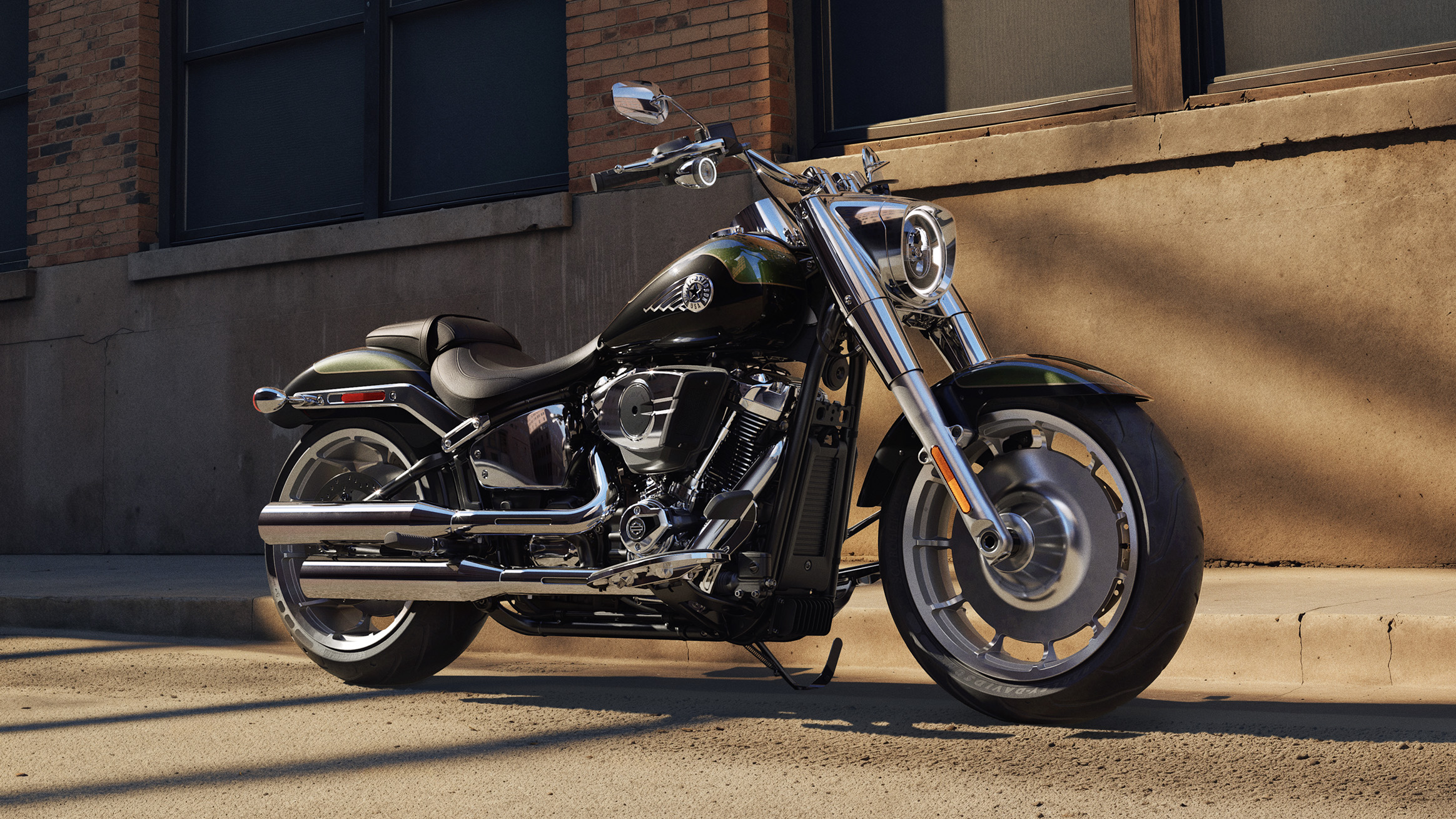
The 2026 Harley-Davidson Fat Boy is one of the most recognisable heavyweight cruisers in the company’s range. Its wide front and rear tyres, machined Lakester wheels, polished headlamp nacelle and muscular proportions give it the unmistakable “steamroller” stance. For 2026, the Fat Boy combines that familiar custom-cruiser identity with the Milwaukee-Eight 117 Custom V-twin, selectable ride modes, LED lighting and standard Rider Safety Enhancements.
India price and availability
Harley-Davidson’s current India product page directs buyers to local dealers for pricing. It does not display a verifiable current 2026 India ex-showroom price in the product information checked for this guide. The older 2025 price should not be assumed to apply to the 2026 model. Request a written quotation from an authorised Harley-Davidson India dealer, with model year, colour, taxes, registration, insurance, accessories and delivery charges itemised.


Engine and performance
The 2026 Fat Boy uses the Milwaukee-Eight 117 Custom 45-degree V-twin engine. Its displacement is 1,923 cc, with a bore of 103.5 mm, stroke of 114.3 mm and compression ratio of 10.3:1. Harley-Davidson lists maximum output at 103 HP (77 kW) at 5,020 rpm and peak torque of 168 Nm at 3,000 rpm. The engine uses Electronic Sequential Port Fuel Injection (ESPFI) and a six-speed transmission.
The Fat Boy is tuned for strong, accessible torque rather than high-revving performance. That character suits relaxed cruising and confident roll-on acceleration. The motorcycle’s size, mass and wide tyres still require smooth inputs, particularly when setting off, slowing down or manoeuvring at walking pace.
2026 Harley-Davidson Fat Boy specifications
| Specification | Official published detail |
|---|---|
| Engine | Milwaukee-Eight 117 Custom, 45-degree V-twin |
| Displacement | 1,923 cc |
| Bore × stroke | 103.5 mm × 114.3 mm |
| Compression ratio | 10.3:1 |
| Maximum power | 103 HP / 77 kW at 5,020 rpm |
| Maximum torque | 168 Nm at 3,000 rpm |
| Fuel system | Electronic Sequential Port Fuel Injection (ESPFI) |
| Exhaust | 2-into-2 staggered; catalyst in muffler |
| Transmission | 6-speed |
| Length | 2,365 mm |
| Width | 965 mm |
| Seat height, unladen | 675 mm |
| Ground clearance | 125 mm |
| Rake | 30 degrees |
| Trail | 104 mm |
| Wheelbase | 1,650 mm |
| Front tyre | 160/60R18, 70V, BW |
| Rear tyre | 240/40R18, 79V, BW |
| Tyres | Michelin Scorcher 11, front and rear |
| Fuel tank capacity | 18.9 litres |
| Oil capacity with filter | 4.7 litres |
| Weight in running order | 315 kg |
| Front suspension | 49 mm telescopic fork with dual-bending valve and dual-rate spring |
| Rear suspension | Hidden free-piston coil-over monoshock with hydraulic preload adjustment |
| Brakes | 4-piston fixed front and 2-piston floating rear calipers |
| Instrument display | 127 mm analogue speedometer with digital information |
| Fuel economy test figure | 5.5 l/100 km under EU 134/2014 method |
| CO₂ test figure | 128 g/km under EU 134/2014 method |
These figures are from Harley-Davidson’s published 2026 India product specification. Confirm the exact India-delivery equipment and homologation details with an authorised dealer.
Design: the unmistakable Fat Boy stance
The Fat Boy’s identity comes from its wide tyres, solid-looking Lakester cast-aluminium wheels, cutback fenders and broad fuel tank. The polished chrome headlamp nacelle is a signature design element. The 2026 model receives a Fat Boy-specific tank medallion and new paint choices, while retaining the classic proportions that have made the model instantly recognisable.
Harley-Davidson lists a 178 mm all-LED headlamp with signature position lighting, LED tail/stop lighting and LED bullet turn signals. The wide front end and chrome nacelle make the motorcycle visually imposing, while the machined wheel finish adds contrast to the bodywork.
2026 colours and finish
The 2026 India product information highlights Olive Steel Metallic two-tone as a new finish, alongside Dark Billiard Gray, Vivid Black, White Onyx Pearl and Brilliant Red. Paint availability can vary by dealer allocation and market. Confirm the exact colour name, finish and model-year code before making a booking.
Wheels, tyres and handling
The Fat Boy uses 18-inch Lakester cast-aluminium wheels with a 160/60R18 front tyre and a particularly wide 240/40R18 rear tyre. The broad rear tyre is central to its distinctive appearance and contributes to the planted custom-cruiser feel. It also makes tyre replacement an important ownership-cost consideration.
The chassis has a 1,650 mm wheelbase, 30-degree rake and 104 mm trail. Harley-Davidson lists a lean angle of 25.6 degrees on both sides. This is a heavyweight cruiser designed for composed road use, not a machine intended for aggressive sport-bike cornering. Riders should allow for its width, steering geometry and mass when turning or filtering through tight spaces.
Suspension and braking
At the front, the Fat Boy uses a 49 mm telescopic fork with dual-bending valve technology, aluminium triple clamps and a dual-rate spring. The rear suspension is a hidden free-piston coil-over monoshock with hydraulic preload adjustment. Braking hardware consists of a four-piston fixed front caliper and a two-piston floating rear caliper.
During a test ride, assess how the suspension deals with the road surfaces you regularly encounter. The listed ground clearance is 125 mm, so take care over steep ramps and unusually tall speed breakers, particularly when carrying a passenger or luggage.


Ride modes, instruments and convenience
The 2026 Fat Boy features selectable ride modes and a 127 mm analogue speedometer with a digital information area. Harley-Davidson lists information including gear, odometer, fuel level, ride modes, heated-gear status, traction control, ABS, tyre-pressure monitoring, cruise-control status, clock, trip, range and tachometer indication. Confirm the precise equipment and menu functions on the India-market motorcycle.
Rider Safety Enhancements
Harley-Davidson lists Rider Safety Enhancements as standard on the 2026 Fat Boy. The manufacturer describes systems intended to assist with traction while accelerating, braking and slowing down. These include:
- Anti-lock Braking System (ABS): designed to help prevent wheel lock under braking and support control during urgent straight-line braking.
- Traction Control System (TCS): helps limit excessive rear-wheel spin during straight-line acceleration.
- Cornering Drag-Torque Slip Control System (C-DSCS): helps manage rear-wheel slip or lock caused by abrupt downshifts or sudden throttle closure, including while cornering.
Do not treat electronic rider aids as a substitute for safe speed, correct tyre pressure, good road judgement and smooth riding. Check the owner’s manual and dealer specification for the exact India-market system configuration.
Fuel economy and running costs
The manufacturer lists fuel economy at 5.5 litres per 100 km under the EU 134/2014 test method and CO₂ emissions of 128 g/km under that method. These are standardised test figures, not guaranteed real-world Indian mileage or emissions measurements under every riding condition. The fuel tank capacity is 18.9 litres.
Ownership budgeting should include fuel, scheduled servicing, insurance, tyres, brake components, accessories and any optional protection package. The wide 240 mm rear tyre can be a notable replacement expense. Ask the dealer for the service schedule, parts availability and a written estimate of routine maintenance costs.
Comfort and everyday practicality
The unladen seat height is 675 mm, which may help some riders reach the ground. However, the Fat Boy weighs 315 kg in running order and is 965 mm wide. Moving it backwards, parking on an incline, making a tight U-turn or navigating a narrow space can require considerable strength and technique. A low seat should not be confused with an easy-to-handle motorcycle.
Check handlebar reach, foot-control position, seat comfort and the ability to support the motorcycle at a stop. Riders who plan regular two-up trips should check the passenger seat, footpegs and comfort on the exact motorcycle or approved accessory configuration.
Who should consider buying the Fat Boy?
- Experienced cruiser riders who want a large-capacity V-twin and strong torque.
- Buyers who value the Fat Boy’s wide-tyre, Lakester-wheel and chrome-nacelle styling.
- Riders who mostly enjoy leisure rides and open-road cruising rather than dense stop-start commuting.
- Motorcycle enthusiasts looking for a distinctive factory custom with modern lighting and rider aids.
- Riders comfortable managing a 315 kg heavyweight motorcycle and its wide rear tyre.
What to check before booking
- Take a test ride and assess throttle response, clutch effort, braking and suspension comfort.
- Check low-speed balance, reversing, parking and U-turn manoeuvrability.
- Assess whether the 675 mm seat height, handlebar reach and foot controls suit your body proportions.
- Check ground clearance against the ramps and speed breakers on your regular routes.
- Ask for the India-specific equipment sheet, owner’s manual and details of the safety systems.
- Get an itemised on-road quotation covering ex-showroom price, taxes, registration, insurance and accessories.
- Confirm model year, manufacturing month, VIN, colour, stock and delivery estimate.
- Ask about rear-tyre replacement cost, service intervals, warranty, labour charges and parts availability.
Advantages and points to consider
Highlights: Milwaukee-Eight 117 Custom engine, 103 HP, 168 Nm torque, wide 240 mm rear tyre, Lakester wheels, signature chrome headlamp nacelle, selectable ride modes, LED lighting and standard Rider Safety Enhancements.
Consider carefully: 315 kg running weight, 965 mm width, wide rear tyre replacement cost, limited lean angle compared with sport-oriented motorcycles and the need to confirm current India pricing and colour availability.
Frequently asked questions
What engine does the 2026 Harley-Davidson Fat Boy use?
It uses a 1,923 cc Milwaukee-Eight 117 Custom V-twin engine.
How much power and torque does it produce?
Harley-Davidson lists 103 HP at 5,020 rpm and 168 Nm at 3,000 rpm.
What is the Fat Boy seat height?
The unladen seat height is 675 mm.
How much does the Fat Boy weigh?
The listed weight in running order is 315 kg.
What is the rear tyre size?
The rear tyre specification is 240/40R18.
What is the fuel tank capacity?
18.9 litres.
What is the 2026 Fat Boy price in India?
The current Harley-Davidson India product page directs buyers to local dealers for pricing. Request a current written quotation from an authorised dealer; do not assume an older model-year price applies.
Official product information
- Harley-Davidson India — 2026 Fat Boy official product page, gallery and technical specifications
- Harley-Davidson India — all motorcycles
Price and specification note: Official manufacturer information checked on 25 November 2026. The current India product page directs buyers to local dealers for pricing; no unverified 2026 India price has been added. The older 2025 price is not presented as a 2026 price. Specifications and colours can vary by market. Fuel economy is a test-cycle figure, not guaranteed real-world mileage. Confirm the final India-delivery specification and quotation with an authorised dealer.
Curated by the team of BoldVoices
#HarleyDavidsonFatBoy #FatBoy2026 #HarleyDavidsonIndia #FatBoyBuyingGuide #MilwaukeeEight117 #HeavyweightCruiser #HarleyDavidsonCruiser #MotorcycleBuyingGuide #BikeSpecifications #BoldVoices


