
7 November 2026 | Curated by Gurdeep Singh, Amritsar, Punjab
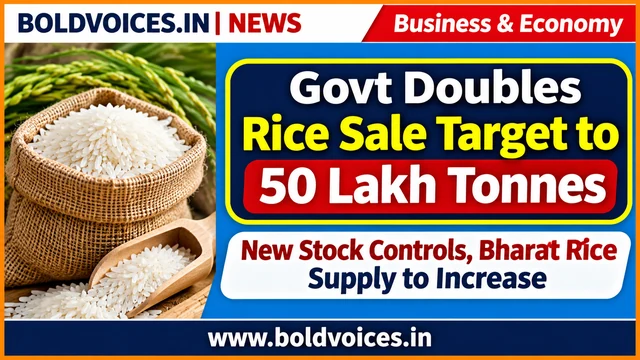
The Government of India has doubled the quantity of rice it plans to sell through the Open Market Sale Scheme (Domestic), raising the 2026–27 target from 25 lakh metric tonnes (LMT) to 50 LMT. The announcement, issued by the Ministry of Consumer Affairs, Food and Public Distribution on 6 November 2026, is part of a wider effort to improve market availability, monitor stocks and moderate retail prices.
The government said that 25 LMT had already been sold to private parties through OMSS (D) e-auctions up to 31 October 2026. During the corresponding period of the previous financial year, sales stood at 11 LMT. The revised target therefore expands the quantity that can be released through the auction channel during the current financial year.
What is OMSS (Domestic)?
The Open Market Sale Scheme (Domestic) is a mechanism through which the government sells foodgrain stocks, including rice, to eligible bulk buyers through e-auctions. The purpose is to make additional supplies available in the market when the government considers intervention necessary. Buyers can use the grain in their business operations and supply chains, subject to the applicable auction terms.
It is important to understand that doubling the target does not mean 50 LMT has already been sold. The revised figure is the target quantity for 2026–27. The government reported that 25 LMT had been sold up to 31 October; further sales will depend on auctions, buyer participation and operational implementation.
Why has the government increased the target?
The stated policy objective is to ensure adequate domestic supplies, maintain price stability, prevent hoarding and safeguard consumers. Rice is a staple food for households across India, and price movements can have a direct effect on food budgets. Releasing additional stocks through an established auction mechanism gives the authorities another route to increase market supply.
The measure should be viewed as a supply-management intervention, not proof by itself of a nationwide rice shortage. Prices and availability can vary by region, variety, quality, transport costs and local market conditions. The impact of additional stocks will depend on how quickly the rice reaches buyers and, ultimately, consumers.
Weekly stock disclosure made mandatory across India
A second major measure is a new order dated 6 November 2026 requiring entities that stock rice and paddy to declare their positions on the Food Stock Portal. The requirement applies across all States and Union Territories to traders and wholesalers, retailers, big-chain retailers, and processors and millers.
Stock information must be submitted every Friday and kept accurate and regularly updated. The reporting covers six categories:
- Basmati rice
- Non-basmati premium rice
- Non-basmati rice
- Parboiled rice
- Broken rice
- Paddy
The portal is intended to give authorities a clearer picture of the quantities held at different points in the supply chain. Better stock visibility can help officials identify unusual accumulation, monitor regional availability and assess whether further action is needed.
The government has stated that entities found unregistered on the portal or violating prescribed stock limits may face appropriate action under Sections 6 and 7 of the Essential Commodities Act, 1955. Businesses should therefore check the applicable directions, complete registration where required and ensure that reported figures match their actual inventories.
Five southern states may impose stock limits
The Centre has conveyed its concurrence to Andhra Pradesh, Karnataka, Kerala, Tamil Nadu and Telangana to impose stock limits on rice and paddy wherever considered necessary. Such limits must be brought into effect through appropriate state control orders. The Centre’s concurrence is not, by itself, an identical stock-limit order operating automatically in every state.
Where state governments issue the relevant orders, the limits are to remain in force up to 31 January 2027. The stated purpose is to help maintain reasonable consumer availability and prevent hoarding and black marketing, particularly in southern markets.
Additional Bharat Rice allocation
The government is also allocating additional quantities of Bharat Rice to NAFED, the National Cooperative Consumers’ Federation of India (NCCF) and Kendriya Bhandar. These agencies have been asked to explore distribution channels that can widen the product’s reach, especially in southern states.
Bharat Rice is intended to provide consumers with an additional affordable purchasing option. Increasing allocations to distribution agencies may help expand access, but the practical benefit will depend on the quantities supplied, local distribution arrangements, retail availability and the price at which the rice is offered.
What could this mean for consumers?
For households, the key question is whether these measures translate into more rice being available through regular markets and Bharat Rice outlets. Additional auction supplies can increase the amount available to bulk buyers, while wider Bharat Rice distribution can create another channel for consumers.
However, consumers should not assume that retail prices will fall immediately or by the same amount everywhere. Local prices also reflect the variety of rice, milling and handling costs, freight, retailer margins and regional supply conditions. The government’s measures may help moderate pressure, but the outcome will need to be assessed using subsequent market prices and availability.
Implications for farmers, millers and traders
For rice millers, processors, wholesalers and retailers, the new reporting requirement adds a compliance responsibility. Businesses should maintain clear inventory records, classify stocks correctly and submit timely Friday updates. Those operating in the five southern states should also monitor state notifications because any enforceable stock limits will depend on the relevant control orders.
For farmers, the measures form part of the wider market environment in which procurement, paddy arrivals, milling demand and local prices interact. The announcement does not itself change the minimum support price or establish a new procurement entitlement. Farmers should continue to refer to official procurement information and prevailing mandi prices for decisions about selling their produce.
What to watch in the coming weeks
- How much additional rice is sold through OMSS (D) auctions after the revised target is announced.
- Whether the additional Bharat Rice allocation reaches retail channels in the intended regions.
- Whether the five states issue stock-limit orders and what limits those orders specify.
- Whether traders and processors comply with weekly Food Stock Portal declarations.
- How wholesale and retail prices respond across different rice varieties and regions.
The bigger picture
The government has combined three policy tools: more rice offered through OMSS (D) auctions, wider distribution of Bharat Rice and closer monitoring of private stocks. These measures address different parts of the supply chain. Auctions add a route for releasing government stocks, Bharat Rice expands a consumer-facing distribution channel, and stock reporting gives authorities more information about inventories.
The announcement is significant, but its success will be judged by implementation rather than targets alone. The amount actually auctioned, the reach of Bharat Rice, the clarity of state orders and the movement of retail prices will show whether the intervention improves availability and eases pressure on household food budgets.
#BharatRice #OMSS #RicePrices #FoodSecurity #IndianAgriculture #EssentialCommoditiesAct #FoodDistribution #BusinessAndEconomy #BoldVoices


