Curated by the Team of Boldvoices 22 November 2026
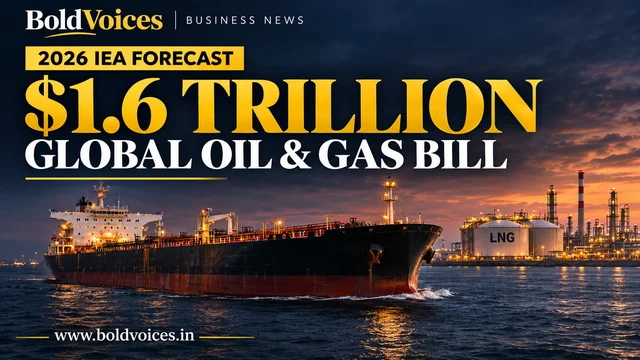
The world is on course to spend US$1.6 trillion on imported oil and natural gas in 2026, according to the International Energy Agency’s World Energy Outlook. That would represent a 25% increase over 2025, despite weaker demand.
The forecast highlights a difficult reality for importing economies: buying less energy does not necessarily mean spending less when supply disruptions push prices higher. The figure represents worldwide spending on imported oil and gas—not India’s import bill or the value of all energy consumption.
Why prices can fall while the annual bill rises
An annual import bill reflects purchases throughout the year. A decline in prices towards the end of the year cannot erase the higher costs paid during earlier months.
Think of a transport company that bought expensive diesel for several months. Cheaper fuel later would improve its next operating budget, but its total annual fuel expenditure could still exceed the previous year’s.
Import volumes, contract terms and the timing of purchases also affect the final bill. For individual countries, currency movements add another layer: a lower dollar price can deliver limited relief if the domestic currency weakens.
Oil supplies are recovering, but vulnerabilities remain
The IEA’s November Oil Market Report, published on 13 November, reported that global oil supply increased to 105.4 million barrels a day in October.
However, the recovery remains uneven. The agency said observed inventories increased largely because more oil was in transit, while stocks held on land continued to decline. It also identified continued tightness in diesel supplies.
Its forecast envisages a global oil surplus in the fourth quarter of 2026, with a larger build in 2027, but warns that attacks on shipping remain a risk to a sustained recovery. These are forecasts subject to changing conditions.
What this means for India
For an importing economy such as India, the impact extends beyond petrol pumps. Energy costs influence freight, manufacturing and the price of materials used across supply chains.
The following are potential economic effects, rather than predictions of specific price increases:
Transport: Higher fuel expenditure can squeeze operators’ margins or feed into delivery charges.
Manufacturing: Businesses using petroleum-based inputs may face pressure on production costs.
Households: Some costs can reach consumers indirectly through goods and services.
External payments: A larger import bill can increase foreign-currency requirements, although exports and capital flows also influence the overall position.
The effect varies between businesses. A company able to pass on higher costs may protect its margins; a smaller supplier working under a fixed-price contract may have less flexibility.
Why cheaper crude does not guarantee cheaper retail fuel
Crude oil and the fuel sold to consumers are different products with different cost structures.
Retail prices also reflect refining, transport, distribution, taxes and commercial pricing decisions. A decline in crude prices therefore does not translate mechanically into an identical reduction at the pump.
Natural-gas buyers face similar timing issues. Their costs can depend on whether purchases are made under longer-term contracts or in the spot market, alongside shipping and terminal charges.
For consumers, the useful signal is an announced change in the price they actually pay. A falling international benchmark alone does not establish that a domestic price cut has occurred.
The international inflation challenge
S&P Global Market Intelligence’s November outlook says falling crude prices should ease some near-term inflation pressure. However, it also identifies broader price pressures that could keep major central banks tightening monetary policy.
Its expectations for further rate increases are the organisation’s forecasts, rather than decisions already announced by central banks.
The economic implication: cheaper energy can provide relief while borrowing remains expensive. Businesses may see one operating cost improve without receiving an equivalent improvement in financing costs.
That matters for investment, housing and consumer spending. A company considering expansion must assess both its energy bill and the cost of funding the project.
What businesses should watch next
The practical indicators extend beyond the daily oil-price headline: reliable deliveries, freight charges, refined-fuel availability and the cost of replenishing inventories all matter.
Businesses can review fuel-sensitive contracts, compare procurement arrangements and improve energy efficiency. These measures can strengthen resilience without requiring a confident prediction about the next movement in prices.
The IEA’s $1.6 trillion forecast captures the accumulated cost of a difficult year. A sustained recovery in supply could improve conditions ahead, but the benefits will depend on dependable shipping, available fuel and how quickly lower costs reach end users.
Like what you read? Help BoldVoices.in keep independent journalism going.
Manage Consent
To provide the best experiences, we use technologies like cookies to store and/or access device information. Consenting to these technologies will allow us to process data such as browsing behavior or unique IDs on this site. Not consenting or withdrawing consent, may adversely affect certain features and functions.
Functional
Always active
The technical storage or access is strictly necessary for the legitimate purpose of enabling the use of a specific service explicitly requested by the subscriber or user, or for the sole purpose of carrying out the transmission of a communication over an electronic communications network.
Preferences
The technical storage or access is necessary for the legitimate purpose of storing preferences that are not requested by the subscriber or user.
Statistics
The technical storage or access that is used exclusively for statistical purposes.The technical storage or access that is used exclusively for anonymous statistical purposes. Without a subpoena, voluntary compliance on the part of your Internet Service Provider, or additional records from a third party, information stored or retrieved for this purpose alone cannot usually be used to identify you.
Marketing
The technical storage or access is required to create user profiles to send advertising, or to track the user on a website or across several websites for similar marketing purposes.