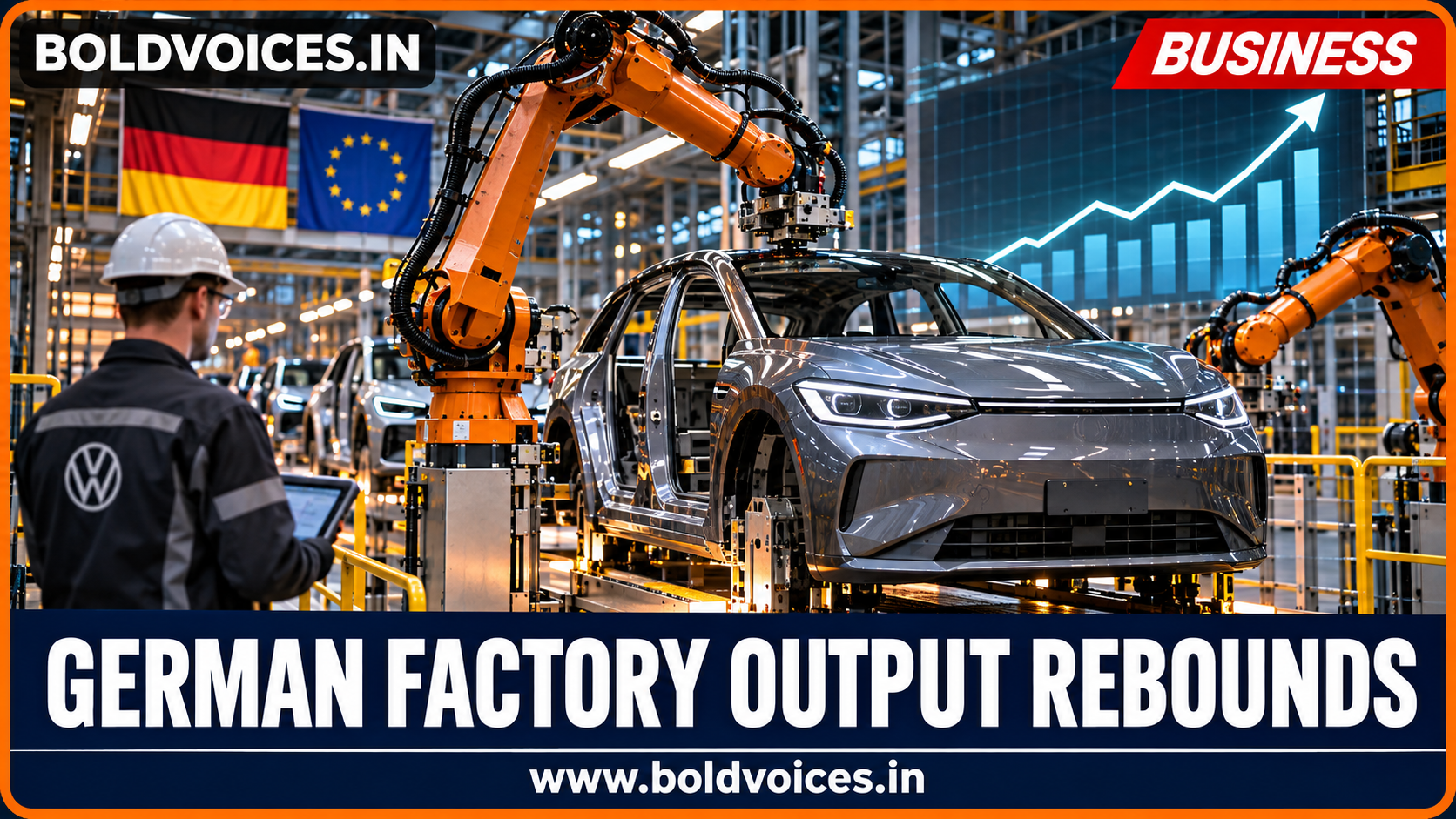
Germany’s industrial engine picked up speed in September, with factory output rising for a second consecutive month. The headline improvement was led by a sharp rebound in car production, but a closer look at the figures shows why the data should be treated as an encouraging patch rather than proof that Europe’s largest economy has entered a durable manufacturing recovery.
Industrial production increased 0.7% from August after seasonal and calendar adjustment, according to provisional figures released on Friday. Output was 0.4% higher than a year earlier. August’s monthly gain was revised down to 1.0% from the earlier estimate of 2.0%, a substantial correction that tempers the recent run of positive readings.
Cars supplied most of September’s lift
The automotive industry was the clearest source of strength. Vehicle production jumped 17.1% in September from the previous month. The increase followed two unusually weak months, when factory holidays and changes to production schedules had held activity down. That makes the rebound striking, but it also means some of the gain reflects production returning to normal after a disrupted summer rather than a sudden surge in underlying demand.
Pharmaceutical production added to the improvement, climbing 8.0% after two softer months. Production in industry excluding energy and construction rose 1.7%. Within that measure, capital-goods output advanced 3.0%, while consumer goods increased 0.8% and intermediate goods edged up 0.1%.
The gains were not broad enough to lift every major area. Construction output fell 2.6% and machinery and equipment production declined 6.5%, reversing part of August’s 5.8% increase in machinery. Energy production was down 1.2%. These opposing moves point to an uneven industrial landscape, with strength concentrated in a few sectors rather than spread across the factory base.
The quarterly picture remains weak
The most important qualification is the comparison across quarters. Despite the monthly gains in August and September, industrial production in the third quarter was 0.4% lower than in the second quarter. A strong monthly print can move the short-term narrative, but the quarter-on-quarter measure suggests the sector had not yet regained momentum over a broader stretch of time.
Energy-intensive industries rose 0.8% in September, but their output was still 3.5% below the second quarter and 1.9% lower than a year earlier. This matters because chemicals, metals, paper and other energy-heavy activities are exposed to operating costs as well as demand. One month of growth does little to resolve the longer-running pressure visible in those branches.
Orders offer a brighter, but volatile, signal
Factory orders had already delivered a more pronounced rebound. Real manufacturing orders rose 4.4% in September after plunging 10.1% in August. Even without large-scale orders, the increase was 5.1%, indicating the improvement was not solely the result of unusually large contracts. Orders for cars and car parts increased 10.5%, while machinery orders grew 8.3%. A major order for engines and turbines contributed to the machinery figure.
Domestic orders climbed 6.6%, while orders from abroad advanced 2.8%. Orders from within the euro area rose 4.5%; those from outside the currency bloc increased 1.6%. Consumer-goods orders recorded a particularly large monthly rise of 14.4%, although movements in the headline series can be amplified by large contracts and timing effects.
The underlying trend in orders was much less dramatic: total orders in the third quarter were only 0.2% above the second quarter, and orders excluding large contracts were up just 0.1%. Manufacturing turnover rose only 0.2% in September from August. That small increase suggests the stronger flow of orders has not yet translated into a comparable acceleration in sales.
What to watch next
For Germany’s economy, the September releases provide a reason for cautious optimism. They show that factories can lift output when production schedules normalize, and the improvement in orders could help sustain activity if it continues. But the quarterly decline in output, the weakness in energy-intensive production and the small rise in turnover leave the recovery unconfirmed.
The next test will be whether stronger orders persist beyond the sharp month-to-month swings seen in August and September, and whether that demand is broad enough to raise production across more industries. Until then, the latest figures tell a story of a factory sector stabilizing unevenly, not one already back on a firm growth path.
Like what you read? Help BoldVoices.in keep independent journalism going.
Manage Consent
To provide the best experiences, we use technologies like cookies to store and/or access device information. Consenting to these technologies will allow us to process data such as browsing behavior or unique IDs on this site. Not consenting or withdrawing consent, may adversely affect certain features and functions.
Functional
Always active
The technical storage or access is strictly necessary for the legitimate purpose of enabling the use of a specific service explicitly requested by the subscriber or user, or for the sole purpose of carrying out the transmission of a communication over an electronic communications network.
Preferences
The technical storage or access is necessary for the legitimate purpose of storing preferences that are not requested by the subscriber or user.
Statistics
The technical storage or access that is used exclusively for statistical purposes.The technical storage or access that is used exclusively for anonymous statistical purposes. Without a subpoena, voluntary compliance on the part of your Internet Service Provider, or additional records from a third party, information stored or retrieved for this purpose alone cannot usually be used to identify you.
Marketing
The technical storage or access is required to create user profiles to send advertising, or to track the user on a website or across several websites for similar marketing purposes.