
Editorial curated by KS Randhawa for boldvoices.in
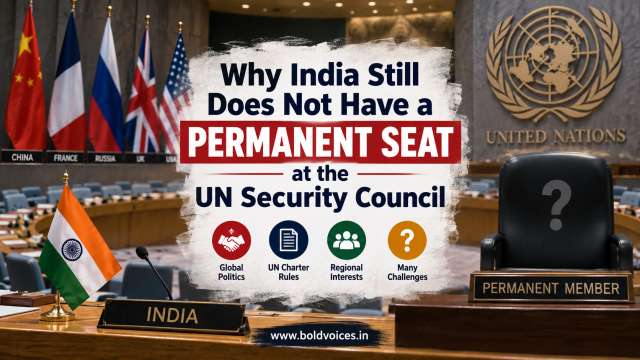
India has been seeking a permanent seat on the United Nations Security Council (UNSC) for many years. India argues that today’s Security Council should better represent the world’s current population, economies and geopolitical realities.
Yet, despite considerable international support for Security Council reform, India still does not have a permanent seat.
So, what is actually stopping it?
1. Changing the UN Charter is extremely difficult
The biggest practical obstacle is that the structure of the Security Council is written into the UN Charter.
Under Article 108, a Charter amendment requires approval by two-thirds of the General Assembly and ratification by two-thirds of UN member states, including all five existing permanent members. The five are the United States, China, Russia, France and the United Kingdom.
This means that a large majority of countries supporting India would still not be enough by itself.
2. China’s position matters greatly
China is one of the five permanent members and therefore has a decisive role in any Charter amendment.
India is part of the G4 group along with Brazil, Germany and Japan, which supports expansion of both permanent and non-permanent membership. However, there is still no final agreement among the major negotiating groups on the overall model for reform.
China has also argued that the question of veto power must be part of the broader reform package.
3. The issue is bigger than India’s membership
The reform debate is not simply about giving India one additional chair.
Countries are discussing:
- How many new permanent members should be created?
- How many new non-permanent seats should be added?
- Which regions should receive representation?
- Should new permanent members receive veto power?
- How should Africa’s representation be addressed?
The African position is an important part of the negotiations, while other groups have their own proposals.
Therefore, reaching a single model acceptable to the wider UN membership is difficult.
4. Veto power is a major disagreement
The existing five permanent members have veto power. A negative vote by any one of them can prevent adoption of a substantive Security Council decision.
India and the G4 have argued that new permanent members should not become a separate “second class” of permanent members. At the same time, the G4 has shown flexibility by proposing that new permanent members could initially refrain from exercising the veto, with the issue reviewed after 15 years.
Other countries have different positions. China has argued that expanding the permanent category without veto rights would not properly address the existing imbalance.
This makes the veto question one of the hardest parts of the negotiations.
5. Some countries prefer more elected seats
Not every country supports creating more permanent seats.
The Uniting for Consensus approach has traditionally favoured expanding elected, non-permanent membership rather than creating additional permanent members.
This creates another divide: should reform give countries longer-term permanent representation, or should more countries get opportunities through elected seats?
6. Regional representation creates another challenge
India is not the only country seeking a permanent position.
Japan, Germany and Brazil are also part of the G4. African countries are seeking stronger representation as a region, while other regions and groups have their own interests.
Therefore, negotiations involve a complicated question of geographical balance as well as individual countries.
7. The reform process itself has been slow
The Intergovernmental Negotiations on Security Council reform have continued for years.
The G4 has repeatedly argued that negotiations should move towards actual text-based negotiations rather than continuing discussions without a final negotiating text. In 2026, the reform process is still continuing without a final agreement.
This is one of the most practical reasons for the delay.
8. India’s support is not the same as a final decision
India has received support from many countries for a permanent seat. It is also an active participant in the G4 and continues to push for expansion of both permanent and non-permanent categories.
But diplomatic support and a legally completed UN reform are two different things.
For India to actually become a permanent member, the wider reform package must ultimately secure the necessary political and legal support.
The Bottom Line
India’s lack of a permanent UNSC seat cannot be explained by one single country or one single reason.
The major practical obstacles are:
1. The difficult UN Charter amendment process
2. The requirement for ratification by all existing permanent members
3. Disagreement over the future of veto power
4. Different proposals for Africa’s representation
5. Competition and differing interests among regional groups
6. Countries that prefer more non-permanent seats
7. Lack of agreement on the total number and structure of new seats
8. The slow pace of the ongoing reform negotiations
The central issue is therefore not simply whether India deserves a permanent seat. The bigger challenge is reaching a global agreement on how the entire Security Council should be redesigned for the 21st century.
As of September 2026, that broader agreement has still not been reached.
Hashtags:
#India #UNSC #UnitedNations #UNReform #PermanentSeat #IndiaAtUN #SecurityCouncil #GlobalPolitics #Geopolitics #InternationalRelations #G4 #Diplomacy #IndiaRising #UNSecurityCouncil #BoldVoices


