November 9, 2026 | Curated by the team of Boldvoices
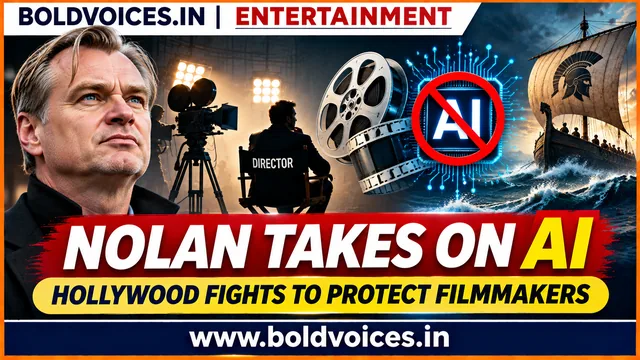
Hollywood’s debate over Artificial Intelligence has entered another important phase. Acclaimed filmmaker Christopher Nolan has spoken out about the growing use of AI in filmmaking, warning that technology companies and film studios must remain accountable for protecting creative work and intellectual property.
The director of Oppenheimer, Inception and the upcoming epic The Odyssey has welcomed stronger safeguards introduced through discussions between the Directors Guild of America (DGA) and the Alliance of Motion Picture and Television Producers (AMPTP).
His message is significant: AI may transform filmmaking, but it should not become an excuse for using artists’ work without proper permission or accountability.
The debate is particularly important as Hollywood faces questions about the future of actors, screenwriters, directors, visual-effects artists and other creative professionals.
1. What has Christopher Nolan said about AI?
In a November 7, 2026 report, entertainment outlet TheWrap — describing Nolan as the Directors Guild of America president — quoted him as saying that studios, not the guilds, must lead enforcement of film copyrights against unauthorized AI copying, praised the DGA–AMPTP AI provisions as a meaningful step forward, and rejected broad AI or fair-use claims as automatic justification for copying protected works.
His concern is that companies may use the complexity of AI to avoid responsibility for decisions involving copyrighted creative material.
Nolan believes studios must take a stronger role in protecting the rights associated with the films they produce.
He also pointed out that directors and other creative professionals do not necessarily own the copyright to the films they work on. In many cases, those rights belong to production companies or studios.
This makes studio accountability particularly important.
2. Why has Hollywood become concerned about Artificial Intelligence?
AI is rapidly changing how films and television programmes can be produced.
Modern tools can generate realistic images, create digital backgrounds, modify performances, reproduce voices and assist with editing.
Some applications offer genuine creative advantages.
For example:
Visual-effects teams can complete certain tasks more efficiently.
Filmmakers can create detailed visual concepts before production.
Background environments can be developed with advanced digital tools.
Editing and post-production workflows can become faster.
Independent filmmakers may gain access to tools previously available only to larger studios.
However, these developments also create difficult questions.
What happens when an AI model is trained using copyrighted films without permission? Can a digital replica of an actor’s face or voice be created without consent? Who owns an image or performance generated using AI?
These are not merely technical questions. They involve copyright, employment, contracts and the future of creative professions.
3. The Directors Guild and Hollywood studios are seeking stronger safeguards
The Directors Guild of America and the Alliance of Motion Picture and Television Producers have recently come together to establish stronger guidelines around AI use in filmmaking.
The discussions reflect a growing recognition that technological development must be balanced with the rights of creative professionals.
Some of the major concerns include:
Protection of copyrighted material: Films, scripts and other creative works should not automatically become training material for AI systems without appropriate legal authority.
Human creative control: Directors should retain meaningful control over artistic decisions and the creative identity of their projects.
Accountability: Studios and technology companies must take responsibility for how AI tools are developed and deployed.
Protection of creative professionals: The industry needs safeguards for people whose performances, voices, images and work may be affected by synthetic media.
The precise application of these safeguards will depend on collective agreements, contracts and applicable copyright laws.
4. Why The Odyssey is part of this important discussion
Nolan’s upcoming film The Odyssey has also become part of the conversation.
The director revealed that the film includes language in its end credits stating that the production should not be ingested or used as training data for AI systems.
This is an important symbolic step because it publicly communicates the production’s position on protecting its creative material.
It also raises a broader question for the entertainment industry: should every major film production establish clear conditions governing how its material can be used by AI developers?
Nolan has expressed satisfaction that the production took this step.
The issue is particularly relevant for major cinematic projects that involve extensive original work, including screenplays, cinematography, music, visual design and performances.
5. Could AI replace actors and filmmakers?
The short answer is that AI is more likely to change many filmmaking jobs than eliminate the need for human creativity altogether.
Several areas are already experiencing technological change.
Actors and digital performances
AI can generate synthetic faces, voices and digital performances.
This raises questions about consent, compensation and the use of an actor’s likeness after a project has been completed.
Screenwriters
AI tools can help with research, outlining and brainstorming.
However, questions remain about originality, copyright and whether automated writing can replace the emotional understanding that human writers bring to stories.
Visual-effects professionals
AI can speed up certain visual-effects tasks, but complex cinematic work still requires artistic judgement, technical expertise and creative direction.
Directors
A director’s job involves far more than operating a camera.
It requires understanding performances, emotions, pacing, storytelling, production design and the overall vision of a film.
AI may become a powerful assistant, but the question of who controls the final creative decisions remains central.
6. Hollywood’s AI debate could influence the global film industry
Hollywood has considerable influence over international filmmaking practices.
Its production agreements, technology standards and legal decisions often influence other entertainment industries.
India’s film industries, including Bollywood, Telugu, Tamil, Malayalam and Kannada cinema, are also adopting advanced digital tools.
AI can potentially reduce certain production costs and help filmmakers create sophisticated visual experiences.
However, Indian actors, writers, directors, musicians and production companies face many of the same questions about copyright and digital consent.
As AI-generated content becomes more realistic, clear contractual protections and transparent production practices will become increasingly important.
7. Finding the balance between technology and creativity
The entertainment industry does not necessarily need to reject Artificial Intelligence.
Used responsibly, AI can support filmmakers, improve production efficiency and make certain creative tools more accessible.
But innovation should not come at the cost of the people whose work makes films possible.
A sustainable approach requires:
Clear permission for the use of protected creative material.
Appropriate consent for digital replicas of actors.
Fair compensation where existing creative work is commercially used.
Transparency about significant AI-generated contributions.
Strong protection for human authorship and creative decision-making.
The challenge for Hollywood is to develop rules that encourage innovation without weakening the rights of artists.
Conclusion: Hollywood’s future will depend on protecting human creativity
Christopher Nolan’s comments reflect a growing concern within the global entertainment industry.
Artificial Intelligence has enormous potential to transform filmmaking, but its use must be accompanied by clear responsibility, legal safeguards and respect for creative ownership.
The debate is not simply about whether machines can make films. It is about who owns the creative material, who benefits from technological advances and how the people behind cinema are protected.
As Hollywood moves towards a more AI-assisted future, the industry will need to ensure that technology remains a tool for creativity rather than a replacement for creative rights.
The future of cinema may be powered by advanced technology, but its creative identity must continue to respect the people who bring stories to life.
Like what you read? Help BoldVoices.in keep independent journalism going.
Manage Consent
To provide the best experiences, we use technologies like cookies to store and/or access device information. Consenting to these technologies will allow us to process data such as browsing behavior or unique IDs on this site. Not consenting or withdrawing consent, may adversely affect certain features and functions.
Functional
Always active
The technical storage or access is strictly necessary for the legitimate purpose of enabling the use of a specific service explicitly requested by the subscriber or user, or for the sole purpose of carrying out the transmission of a communication over an electronic communications network.
Preferences
The technical storage or access is necessary for the legitimate purpose of storing preferences that are not requested by the subscriber or user.
Statistics
The technical storage or access that is used exclusively for statistical purposes.The technical storage or access that is used exclusively for anonymous statistical purposes. Without a subpoena, voluntary compliance on the part of your Internet Service Provider, or additional records from a third party, information stored or retrieved for this purpose alone cannot usually be used to identify you.
Marketing
The technical storage or access is required to create user profiles to send advertising, or to track the user on a website or across several websites for similar marketing purposes.