
Updated: 31 October 2026, 1:10 PM IST
Curated by the Team of Boldvoices
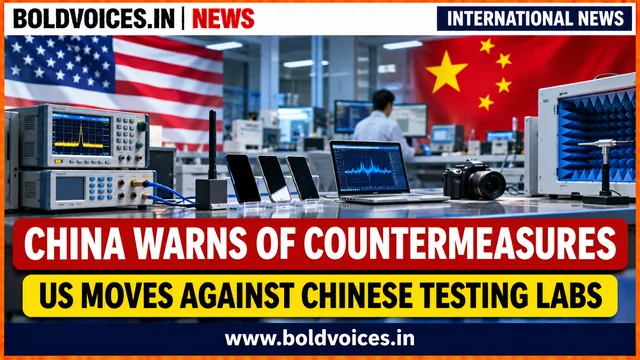
China has warned that it could take further countermeasures after the United States moved to restrict the use of Chinese laboratories for testing electronic devices seeking approval for the American market. The dispute adds a new pressure point to already strained trade and technology relations between the world’s two largest economies.
What the FCC has decided
On 29 October, the US Federal Communications Commission (FCC) adopted rules limiting recognition of testing laboratories, telecommunications certification bodies and laboratory accreditation bodies to facilities in the United States or in jurisdictions that provide qualifying reciprocal treatment. The restrictions are scheduled to take effect on 1 December 2028.
The measure concerns where recognised testing, certification and accreditation work can be carried out for devices subject to the FCC’s equipment-authorisation framework. It is not a blanket ban on Chinese-made electronics or on their sale in the United States.
The transition period runs until 1 December 2028. The FCC’s reciprocal-economy concept includes jurisdictions with a mutual recognition agreement or a comparable government-to-government reciprocity arrangement. The change gives manufacturers, testing organisations and regulators time to adjust their arrangements.
Why Washington says the change is necessary
US officials have framed the measure as part of a broader effort to protect national security, technology information and the integrity of the equipment authorisation system. FCC Chairman Brendan Carr has pointed to the concentration of electronics testing in China, arguing that the United States should not remain heavily dependent on facilities in a country it considers a strategic competitor.
Testing laboratories can handle technical specifications, product designs and other sensitive information while assessing whether devices comply with radio-frequency and communications requirements. The US position is that reciprocal access and trusted testing arrangements are necessary safeguards as technology competition intensifies.
Beijing threatens countermeasures
China’s Ministry of Commerce said on 30 October that it firmly opposed the FCC vote, said Beijing had already taken countermeasures in response to earlier US measures, and warned it would take further necessary action if Washington proceeded unilaterally. The ministry also said China had proposed bilateral mutual-recognition talks and remained open to consultation.
Beijing argues that Chinese testing laboratories are an important part of the global electronics certification system. It says restricting their role could raise compliance costs, lengthen product-development and delivery cycles, and disrupt supply chains used by companies in several countries. China has urged Washington to withdraw the measure while saying it remains open to consultation.
What it means for manufacturers and consumers
Companies that currently rely on affected laboratories may need to shift testing to eligible facilities in the United States or other recognised jurisdictions. That transition could increase demand at alternative laboratories and require manufacturers to review certification schedules, supplier contracts and product-launch plans.
The order also protects existing approvals: equipment authorisations granted, and applications received, before 1 December 2028 are not disturbed. Devices already certified remain certified without retesting. Pre-compliance research, development and debugging tests that are not relied on as FCC-recognised testing are outside this restriction. Manufacturers should nevertheless plan to move FCC-recognised testing and certification for later applications to eligible facilities before the transition ends.
Could India be affected?
The policy may also matter to testing facilities outside China because its criteria extend to other economies that lack qualifying reciprocal arrangements with the United States. Indian electronics exporters and laboratories will therefore be watching how the FCC defines eligible partners and comparable agreements.
As of the FCC order released on 30 October, Appendix D identifies 62 reciprocal economies and does not list India. Indian testing facilities should therefore not assume they will remain eligible for FCC-recognised certification work after 1 December 2028 unless the FCC adds India or recognises a qualifying government-to-government arrangement. The FCC’s Office of Engineering and Technology can update the list, so manufacturers should verify the current position before committing to post-transition testing contracts.
A new front in the technology rivalry
The testing dispute demonstrates how technical standards and certification procedures are becoming instruments of strategic competition. Earlier disagreements focused heavily on tariffs, semiconductors, telecommunications equipment and advanced computing. The latest move reaches deeper into the infrastructure that allows products to be tested and cleared for sale.
For global manufacturers, the central concern is predictability. Businesses need clear rules, sufficient testing capacity and reliable recognition arrangements to move products across borders. If Washington and Beijing cannot resolve the dispute through consultation, companies may face another layer of fragmentation in an already complex technology supply chain.
The immediate test will be whether the two governments can negotiate a workable reciprocal framework before the December 2028 implementation date. Until then, manufacturers and testing organisations will have to plan for a more divided regulatory environment.
Hashtags: #USChinaRelations #FCC #China #UnitedStates #ElectronicsTesting #TechnologyTrade #GlobalSupplyChains #TradeDispute #IndiaElectronics


