Curated by the Team of Boldvoices 22 November 2026
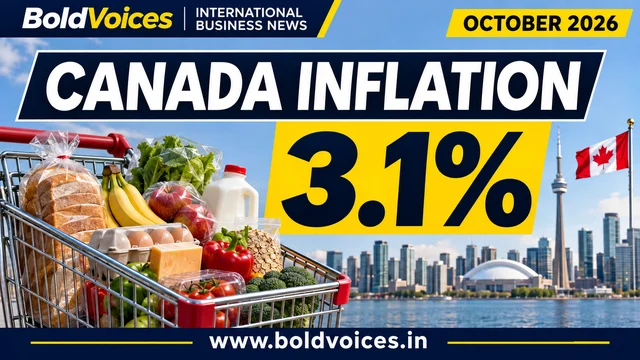
Canada’s annual inflation rate held at 3.1% in October 2026, matching September’s reading, according to Statistics Canada’s release published on 16 November.
Consumer prices increased 0.2% from September to October, both before and after seasonal adjustment. The annual figure compares prices with October last year; it does not mean prices rose 3.1% during a single month.
The main price movements
Measure
October 2026 annual change
Overall Consumer Price Index
+3.1%
Food purchased from stores
+2.0%
Shelter
+1.4%
Transportation
+8.9%
Gasoline
+30.9%
Gasoline prices nevertheless fell 2.5% during October itself. The monthly decline and annual increase describe different comparisons and can occur together.
Why unchanged inflation does not mean unchanged prices
Analysis: Inflation measures the pace of price change. A stable annual rate means the overall basket is increasing at a similar pace to the previous reading.
It does not mean prices have stopped rising or returned to earlier levels.
For households, affordability depends on the relationship between expenses and income. A family whose earnings have not kept pace with essential costs can remain under pressure even when the headline inflation rate is unchanged.
The practical question is how much money remains after paying for necessities.
Gasoline shows why the comparison period matters
Statistics Canada said gasoline’s faster annual increase partly reflected a base-year effect: a price decline in October 2025 fell out of the twelve-month comparison.
Analysis: An annual rate depends on both today’s price level and the starting point a year earlier.
Imagine a price index falling sharply in one month and recovering later. When that unusually low month becomes the comparison point, annual inflation can look stronger—even if prices have recently eased.
Readers should therefore examine the monthly movement alongside the annual rate before concluding that a product became more expensive during the latest month.
Grocery inflation and the price level are different questions
Analysis: A slower rate of grocery inflation would mean prices are rising less quickly. It would not necessarily mean the shopping basket costs less.
Households also buy different combinations of products. Changes in food preferences, household size and purchasing habits can produce an experience that differs from the national average.
For budgeting, tracking a consistent basket can help distinguish changes in prices from changes in what the household buys.
Retailers face a related commercial question: whether customers respond by switching products, choosing smaller quantities or delaying discretionary purchases.
Shelter inflation needs careful interpretation
Analysis: The shelter component is a broad statistical category, rather than a quote for a particular rental property.
It should not be read as evidence that every tenant’s rent increased by the same percentage or that a newcomer can find accommodation at a national average price.
Location, property type and individual arrangements remain important. Anyone planning a move should compare suitable local listings and total living expenses rather than rely on the headline inflation rate alone.
What businesses should take from the release
Analysis: Companies need to understand both their own costs and their customers’ spending capacity.
A transport-intensive business can face different pressures from a firm whose main expenses are wages and software. Businesses selling discretionary goods may also encounter customers prioritising essential purchases.
The useful response is to review actual invoices, margins and order patterns.
A national inflation figure provides context, but it cannot establish how much an individual company should change its prices.
The implications for people moving from India
Analysis: Indian workers, students and families considering Canada should build a location-specific budget.
Compare expected take-home income with accommodation, groceries, transport, utilities and other recurring expenses. Initial moving costs and a contingency fund should be considered separately.
An inflation rate describes changes over time; it does not establish whether a particular salary will cover a household’s needs.
Currency movements also matter when expenses are paid in Canadian dollars but savings or family support originate in India.
Does this settle the next interest-rate decision?
Analysis: The CPI release alone does not determine the Bank of Canada’s next decision.
Policymakers assess underlying price trends, economic activity and other evidence alongside headline inflation. An unchanged reading should therefore not be presented as confirmation of either a rate hold or a rate change.
Borrowers should distinguish announced decisions from forecasts when reviewing their financing plans.
What to watch next
Statistics Canada schedules November’s CPI release for 14 December 2026.
Analysis: The next question is whether price pressure eases across more categories and whether household incomes improve purchasing power.
For now, the unchanged headline conceals different movements beneath the surface—making the composition of inflation as useful as the overall rate.
Like what you read? Help BoldVoices.in keep independent journalism going.
Manage Consent
To provide the best experiences, we use technologies like cookies to store and/or access device information. Consenting to these technologies will allow us to process data such as browsing behavior or unique IDs on this site. Not consenting or withdrawing consent, may adversely affect certain features and functions.
Functional
Always active
The technical storage or access is strictly necessary for the legitimate purpose of enabling the use of a specific service explicitly requested by the subscriber or user, or for the sole purpose of carrying out the transmission of a communication over an electronic communications network.
Preferences
The technical storage or access is necessary for the legitimate purpose of storing preferences that are not requested by the subscriber or user.
Statistics
The technical storage or access that is used exclusively for statistical purposes.The technical storage or access that is used exclusively for anonymous statistical purposes. Without a subpoena, voluntary compliance on the part of your Internet Service Provider, or additional records from a third party, information stored or retrieved for this purpose alone cannot usually be used to identify you.
Marketing
The technical storage or access is required to create user profiles to send advertising, or to track the user on a website or across several websites for similar marketing purposes.