
Editorial | 19 November 2026 | Team of Boldvoices
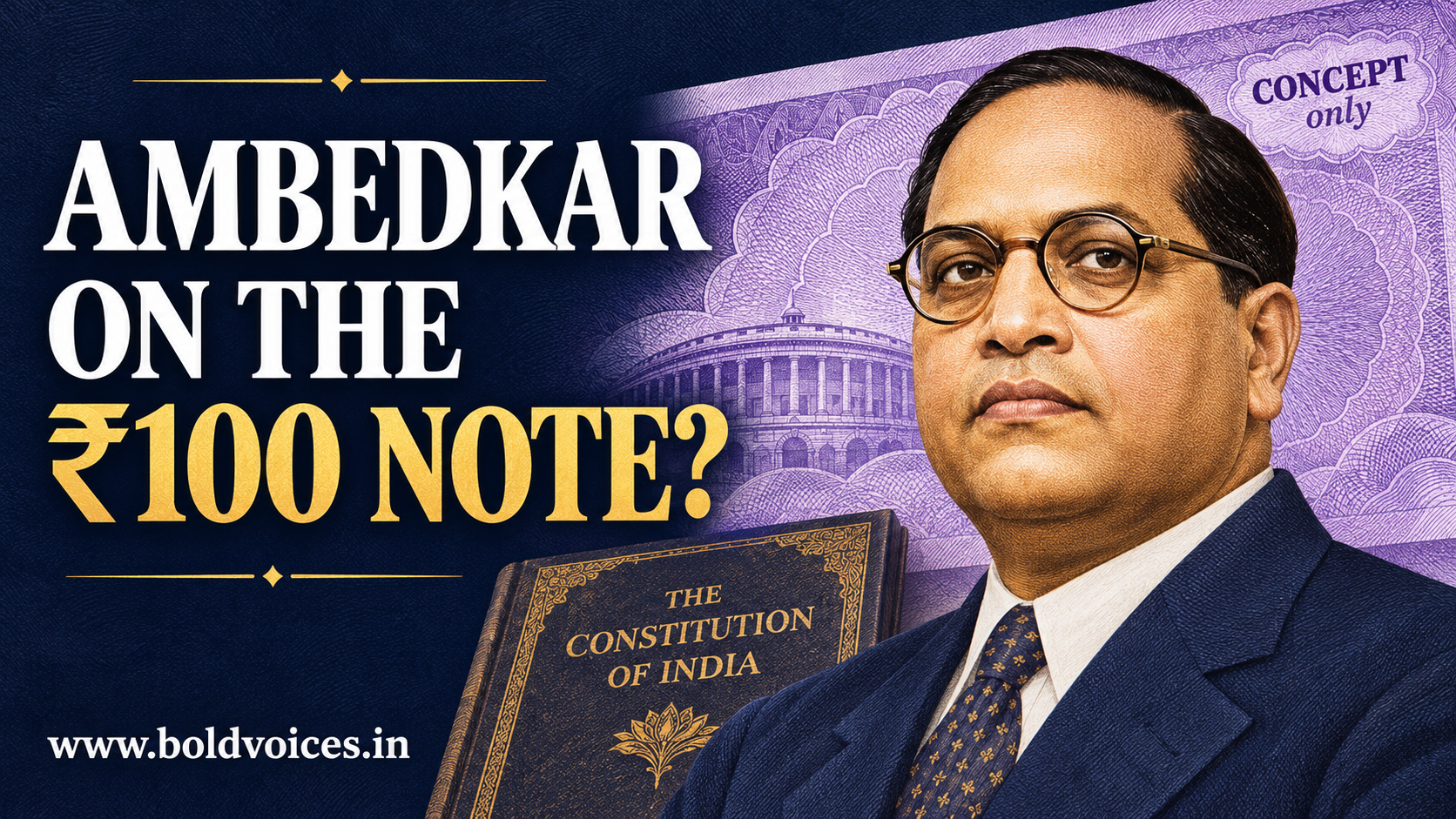
A banknote passes from a farmer to a shopkeeper, from a parent to a child, from a customer to a worker at the end of a shift. It is one of the few objects issued by the state that people encounter in the ordinary course of a day. The portrait on it tells a story about what India chooses to remember. The next time India redesigns a widely used banknote, that story should include Dr. Bhimrao Ramji Ambedkar.
Mahatma Gandhi’s portrait carries the memory of a freedom struggle that drew ordinary Indians into public life and made nonviolent resistance a force the world had to reckon with. That contribution deserves enduring respect. Putting Ambedkar on the front of a future denomination would honour another defining achievement in India’s history: building a republic where the person least powerful in society could claim rights against the most powerful institutions in the land.
He helped turn the promises of independence into rights
As chairman of the Constituent Assembly’s Drafting Committee, Ambedkar introduced the Draft Constitution in November 1948 and defended its provisions through debate. The Constitution was a collective achievement, shaped by the Assembly, its committees and its constitutional advisers. Ambedkar’s particular contribution was to help turn that work into a coherent legal framework and explain, provision by provision, how it would govern a country of immense diversity. The Assembly adopted the Constitution on 26 November 1949, and it came into force on 26 January 1950.
The clearest example of his thinking is Article 32. A fundamental right can seem remote to someone who has no way to enforce it. Article 32 gives people the right to approach the Supreme Court to enforce their fundamental rights. Ambedkar called it the Constitution’s “very soul” and “very heart.” He understood the difference that an enforceable right makes to someone who otherwise has to rely on the goodwill of an official, a local authority or a powerful neighbour.
That same concern ran through his closing address to the Constituent Assembly. India was about to give citizens an equal vote while remaining deeply unequal in social and economic life. A person could enter a polling booth as an equal and return to a village where caste dictated access to water, work or public space. Ambedkar wanted the republic to confront that contradiction. It is still a good test of how seriously we take his legacy.
He fought caste exclusion where people lived it
In 1927, Ambedkar led the Mahad Satyagraha in present-day Maharashtra to assert the right of people treated as untouchable to draw water from a public tank. The demand was specific and practical. A person should be able to drink from a public water source without seeking permission from another caste. The resistance the movement faced exposed how deeply hierarchy was embedded in the simplest acts of daily life.
The Constitution gave that struggle a national legal foundation. Article 17 abolished untouchability and made the enforcement of disabilities arising from it punishable by law. Article 15 prohibits specified forms of discrimination, including on grounds of caste and sex, and addresses access to public places and facilities. Article 16 guarantees equality of opportunity in public employment and provides a constitutional basis for reservation for backward classes that are inadequately represented in state services. Article 46, a Directive Principle, calls on the state to promote the educational and economic interests of weaker sections, with particular attention to Scheduled Castes and Scheduled Tribes, and to protect them from social injustice and exploitation.
These provisions speak to different problems. A student needs a fair chance to enter a classroom. A qualified applicant needs a fair chance at public employment. Communities kept out of institutions for generations need avenues to participate in them. Ambedkar pressed India to take all three seriously. That is why his contribution belongs in the national story of citizenship as much as it belongs in the history of the Dalit movement.
He took women’s equality into the home
As independent India’s first Law Minister, Ambedkar championed the Hindu Code Bill. It addressed marriage, divorce, adoption and inheritance under Hindu personal law. The issues were immediate and personal. Could a woman claim a share in family property? What legal options did she have if a marriage broke down? What authority did she have over decisions that shaped her own household?
Property mattered because it affected a woman’s ability to support herself and make decisions about her future. Divorce law mattered because a legal route out of a marriage could change the options available to a woman in a difficult home. Ambedkar was willing to spend political capital on these questions at a time when they were easy for lawmakers to postpone.
The bill stalled. Its failure to advance was a major reason he gave for resigning from the Cabinet in 1951. Parliament later enacted separate laws on Hindu marriage, succession, adoption and maintenance, and minority and guardianship in 1955 and 1956. Those laws took up parts of the reform agenda through a different legislative route, and the law continued to evolve in the decades that followed. Ambedkar’s achievement was to insist, at the founding of the republic, that women’s standing within the family deserved the full attention of lawmakers.
He asked who benefited from the farmer’s work
Ambedkar was trained in economics at Columbia University and the London School of Economics. He brought that training to a question that still matters in agricultural debates. What happens when the people who do the work have too little control over the land they cultivate, too little capital to improve it and too few alternatives if cultivation falls short?
In his 1918 essay Small Holdings in India and Their Remedies, he argued that the size of a plot told only part of the story. Productivity also depended on the capital available to cultivators and the wider economy’s ability to create work beyond agriculture. Industrial employment, in his analysis, could ease pressure on the land, while investment could make cultivation more productive. It was an argument about how to improve a rural household’s choices and income.
He pursued the question of power over land in the Bombay Legislative Assembly. In 1937, he moved to introduce a bill to abolish the Khoti system, a form of intermediary land tenure found in parts of the Bombay Presidency. His proposal sought a direct relationship between the government and cultivators in possession, reducing the role of intermediaries. The underlying question was simple. Who should have security and bargaining power when one person tills the land and another controls the terms?
He made working conditions a public responsibility
As Labour Member of the Viceroy’s Executive Council from 1942 to 1946, Ambedkar helped advance shorter working hours and supported the development of employment exchanges. His record in labour policy deserves a place beside his constitutional work. The length of a factory shift determines how much time a person has to rest, see their family or pursue an education. Access to reliable information about vacancies can determine whether a job seeker ever gets a chance to apply.
Across his work on labour, agriculture and social reform, Ambedkar repeatedly paid attention to people with limited power to bargain. The worker facing an exhausting shift, the tenant dealing with an intermediary and the woman with a weak claim to family property lived under different rules. In each case, changing the rules could give someone more control over their own life. That is the breadth of the contribution an Ambedkar banknote would recognise.
Put Ambedkar on the next redesigned ₹100 note
India has changed the principal image on its banknotes before. The Ashoka Lion Capital appeared prominently on earlier notes. The Reserve Bank of India introduced the Mahatma Gandhi Series in 1996 and retained the Lion Capital elsewhere on the front. That history gives India room to think seriously about how future designs can honour more of its founding legacy.
A practical proposal would be to put Ambedkar’s portrait on the front of the next redesigned ₹100 banknote, with the original Constitution as a possible motif on the reverse. Gandhi’s portrait could continue on other denominations. The new design could enter circulation through the ordinary replacement cycle, with clear public guidance and the same attention to accessibility, denomination recognition and security that any redesign requires. Under Section 25 of the Reserve Bank of India Act, the Central Government approves banknote designs after considering the recommendations of the RBI’s Central Board.
A portrait cannot enforce a right or improve a worker’s conditions. It can prompt a question that leads somewhere. A child who asks why Ambedkar is on the ₹100 note can learn about a public tank in Mahad, a woman’s claim to inherit, the rights of a cultivator and the citizen’s right to go to court. Those stories belong to the same republic. It is time one of India’s everyday banknotes carried his face.
#BRAmbedkar #IndianConstitution #IndianCurrency #SocialJustice #WomensRights #BoldVoices


