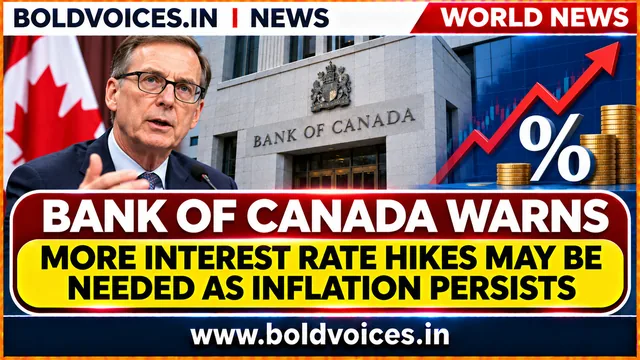
The Bank of Canada has indicated that further interest rate increases may be needed if inflation does not return towards its target, adding uncertainty for Canadian households, businesses and borrowers. Governor Tiff Macklem made the remarks while appearing before the House of Commons Finance Committee on November 3.
The comments follow the central bank’s October 28 decision to raise its benchmark policy rate by 25 basis points to 2.5%. It was the Bank of Canada’s first rate increase in three years, signalling a shift after an extended period in which borrowing costs had been held or reduced.
Why further rate increases remain possible
The Bank of Canada aims to keep inflation close to its 2% target. However, price pressures remain a concern, including the potential for higher energy costs to feed into transportation, production and household expenses.
Macklem’s comments indicate that the central bank is not ruling out additional tightening if inflation proves persistent. Any future decision will depend on incoming evidence, including consumer prices, employment, economic growth and inflation expectations. The governor’s warning should not be interpreted as a pre-announced schedule of rate increases.
Government spending and the inflation fight
During his parliamentary testimony, Macklem also addressed the relationship between federal fiscal policy and monetary policy. He said the government’s current fiscal approach was not undermining the central bank’s efforts to control inflation.
The distinction matters because government spending and central bank interest-rate decisions influence the economy through different channels. The Bank of Canada would be concerned if fiscal policy became unsustainable or materially complicated the return of inflation to its target, but Macklem said those conditions did not currently apply.
How higher interest rates affect Canadians
Mortgage borrowers: People with variable-rate mortgages may face higher payments or interest costs as lenders adjust their rates. Those renewing fixed-rate mortgages will be affected by prevailing market rates and their individual loan terms.
Homebuyers: Higher borrowing costs can reduce the amount households are able to borrow and may make housing less affordable.
Businesses: Companies that rely on loans for expansion, equipment or working capital may face more expensive financing, potentially delaying investment.
Savers: Some savings accounts and deposit products may offer better returns when interest rates rise, although rates vary between financial institutions.
The challenge for Canada’s economy
Higher interest rates can cool inflation by moderating borrowing and demand. But they can also slow consumer spending, business investment and overall economic activity. The central bank therefore has to balance price stability against the risk of putting unnecessary pressure on jobs and growth.
The Bank of Canada’s October outlook projected inflation could remain around 3% through much of 2027 before moving closer to 2% by the middle of 2028. The path will depend on how energy prices, domestic demand and other economic factors develop.
What to watch next
Investors, homeowners and businesses will be watching upcoming Canadian inflation and employment data for clues about the central bank’s next move. The Bank of Canada has not committed to another increase; it will assess the evidence at each policy decision.
For households, the practical message is to prepare for the possibility that borrowing costs may remain higher or rise further if inflation stays persistent. The direction of policy will become clearer as new economic data arrives.
Like what you read? Help BoldVoices.in keep independent journalism going.
Manage Consent
To provide the best experiences, we use technologies like cookies to store and/or access device information. Consenting to these technologies will allow us to process data such as browsing behavior or unique IDs on this site. Not consenting or withdrawing consent, may adversely affect certain features and functions.
Functional
Always active
The technical storage or access is strictly necessary for the legitimate purpose of enabling the use of a specific service explicitly requested by the subscriber or user, or for the sole purpose of carrying out the transmission of a communication over an electronic communications network.
Preferences
The technical storage or access is necessary for the legitimate purpose of storing preferences that are not requested by the subscriber or user.
Statistics
The technical storage or access that is used exclusively for statistical purposes.The technical storage or access that is used exclusively for anonymous statistical purposes. Without a subpoena, voluntary compliance on the part of your Internet Service Provider, or additional records from a third party, information stored or retrieved for this purpose alone cannot usually be used to identify you.
Marketing
The technical storage or access is required to create user profiles to send advertising, or to track the user on a website or across several websites for similar marketing purposes.