
Curated by the Financial Desk of Boldvoices
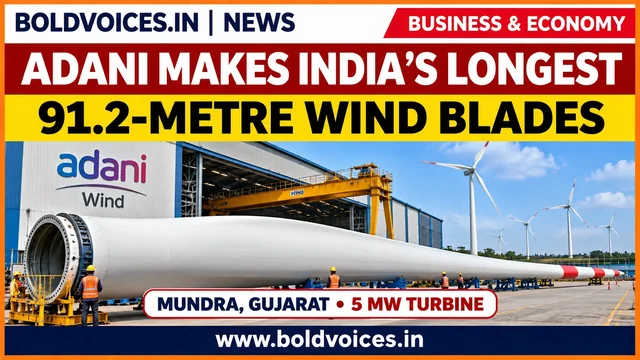
India’s renewable-energy manufacturing industry has reached an important milestone as Adani Wind begins producing the country’s longest domestically manufactured onshore wind turbine blades. The 91.2-metre blades are being made at Adani New Industries Limited’s integrated facility in Mundra, Gujarat. Announced on 16 November 2026, the development represents an advance in India’s ability to manufacture larger wind-energy equipment. The company has also received certification for its new 5 MW turbine platform, clearing an important technical requirement for serial production.
What exactly has Adani achieved?
Adani Wind, the wind-energy manufacturing division of Adani New Industries Limited, has commenced production of 91.2-metre blades for its MWL185-5.0 MW wind turbine platform. Adani New Industries is a wholly owned subsidiary of Adani Enterprises.
| Feature | Specification |
|---|---|
| Blade length | 91.2 metres |
| Turbine platform | MWL185-5.0 MW |
| Rated capacity | 5 MW |
| Rotor diameter | 185 metres |
| Hub height | 140 metres |
| Rotor swept area | Approximately 26,600 square metres |
| Manufacturing location | Mundra, Gujarat |
| Certification agency | WindGuard Certification GmbH |
| Technology partner | W2E, Germany |
According to the company, these are the longest wind turbine blades manufactured in India. This is a claim about domestically manufactured onshore turbine blades, not the longest blades anywhere in the world.
Why are longer wind turbine blades important?
A wind turbine converts moving air into electricity. Its blades capture wind energy and drive the rotor connected to generating equipment. Larger blades sweep a greater area, potentially increasing the energy available for capture, including at moderate-wind sites. Adani’s 185-metre rotor sweeps approximately 26,600 square metres. However, bigger blades do not guarantee higher generation everywhere: wind conditions, turbine design, maintenance, operational availability and grid connectivity also matter.
A major step forward at Mundra
The Mundra facility already manufactures 78.6-metre and 80.5-metre blades. Moving to 91.2 metres increases manufacturing complexity and requires specialised materials, precise engineering and carefully controlled production. Blades must withstand changing wind loads while remaining light enough to operate efficiently. Their size also presents handling, storage and transportation challenges. The milestone demonstrates growing domestic capabilities in advanced renewable-energy equipment.
What does the certification mean?
WindGuard Certification GmbH, an independent German testing and certification organisation, certified the MWL185-5.0 MW platform following prototype testing at Mundra. The platform was developed with German technology company W2E, also known as Wind to Energy. According to Adani, certification confirms conformity with internationally recognised IEC 61400 wind-turbine standards. It clears an important step towards serial production, but is not equivalent to completed commercial deliveries or confirmed sales revenue.
Adani Wind’s existing manufacturing business
Adani Wind reports existing manufacturing capacity of 2.25 GW and intends to expand it. Its turbine portfolio spans approximately 3 MW to 5 MW classes. The company says its MWL160-5.2 MW platform has crossed 2 GW of installations at Khavda, Gujarat, and cumulative orders from independent power producers outside the Adani Group have exceeded 1 GW. Serving external customers matters because it reduces exclusive reliance on the group’s own projects. Future performance will depend on converting orders into deliveries, meeting quality standards and controlling costs.
Why this matters for Make in India
Renewable-energy development requires more than installing wind farms. India needs manufacturing capabilities for blades, towers, generators, gearboxes, power electronics and control systems. Producing more equipment domestically can create opportunities for engineering firms, suppliers and industrial services and may reduce dependence on certain imports. The extent of import substitution, however, depends on domestic content across the complete turbine, not simply the location of final assembly. Technology partnerships, local supplier development and research remain essential.
Can larger turbines reduce wind-power costs?
Higher-capacity turbines may allow developers to install fewer machines for a given project capacity. Larger rotors can improve energy capture at suitable sites, potentially reducing certain costs per unit of electricity. But oversized equipment requires specialised transport, installation and maintenance. Project economics depend on equipment price, financing, wind conditions, grid infrastructure and actual generation. The new 5 MW platform should not be assumed to deliver cheaper electricity automatically; operational data will be needed.
What does it mean for India’s renewable-energy sector?
Wind can complement solar because generation follows different daily and seasonal patterns. Combining technologies may diversify electricity supply, but reliable integration also requires transmission, forecasting, flexible generation and energy storage. Domestic access to more capable turbines may support future projects, while land availability, project finance and grid connectivity remain important constraints.
Opportunities for businesses and workers
Advanced turbine manufacturing can create opportunities for engineering companies, specialised component suppliers, logistics firms transporting oversized equipment, testing laboratories and maintenance contractors. Production requires engineers, technicians and quality-control specialists. No specific number of new jobs was announced in connection with the 91.2-metre blade milestone, so its employment impact should be evaluated through subsequent disclosures rather than unsupported estimates.
Can Adani compete globally?
The international turbine market includes established manufacturers with large technology portfolios and service networks. Competition requires engineering expertise, manufacturing scale, reliable products and after-sales support. Adani says it was the only Indian wind-turbine manufacturer in BloombergNEF’s Global Top 15 ranking for 2025. The company also operates a technology centre in Rostock, Germany, and maintains research and development capabilities in India. Long-term competitiveness depends on verified turbine performance, delivery execution, customer satisfaction and financial results.
What investors should watch
The milestone highlights Adani Enterprises’ exposure to renewable-energy equipment manufacturing, but it does not establish a specific revenue or profit increase. Important indicators include external orders, deliveries of the certified 5 MW platform, manufacturing-capacity expansion, deployed turbine reliability, profitability, working-capital needs and domestic and international demand. A technological achievement becomes financially meaningful when it translates into sustainable commercial performance.
Challenges ahead
Blades exceeding 90 metres require specialised routes, vehicles and handling equipment. Manufacturers must maintain quality across large components, while wind projects face land, grid, finance and regulatory challenges. Competition from established domestic and international producers adds pressure. The next phase is to demonstrate reliable production, efficient delivery and economical operation.
The bottom line
Adani Wind’s production of 91.2-metre turbine blades at Mundra is a milestone for India’s renewable-energy equipment industry. Domestic blade manufacturing and certification of a 5 MW turbine platform strengthen capabilities in advanced wind technology. For Adani Enterprises, the development may create future commercial opportunities; for India, it demonstrates the potential for more sophisticated local manufacturing. The next test is commercial deployment, operational reliability and long-term economic value.
#AdaniGroup #AdaniWind #MakeInIndia #WindEnergy #RenewableEnergy #BusinessNews


