
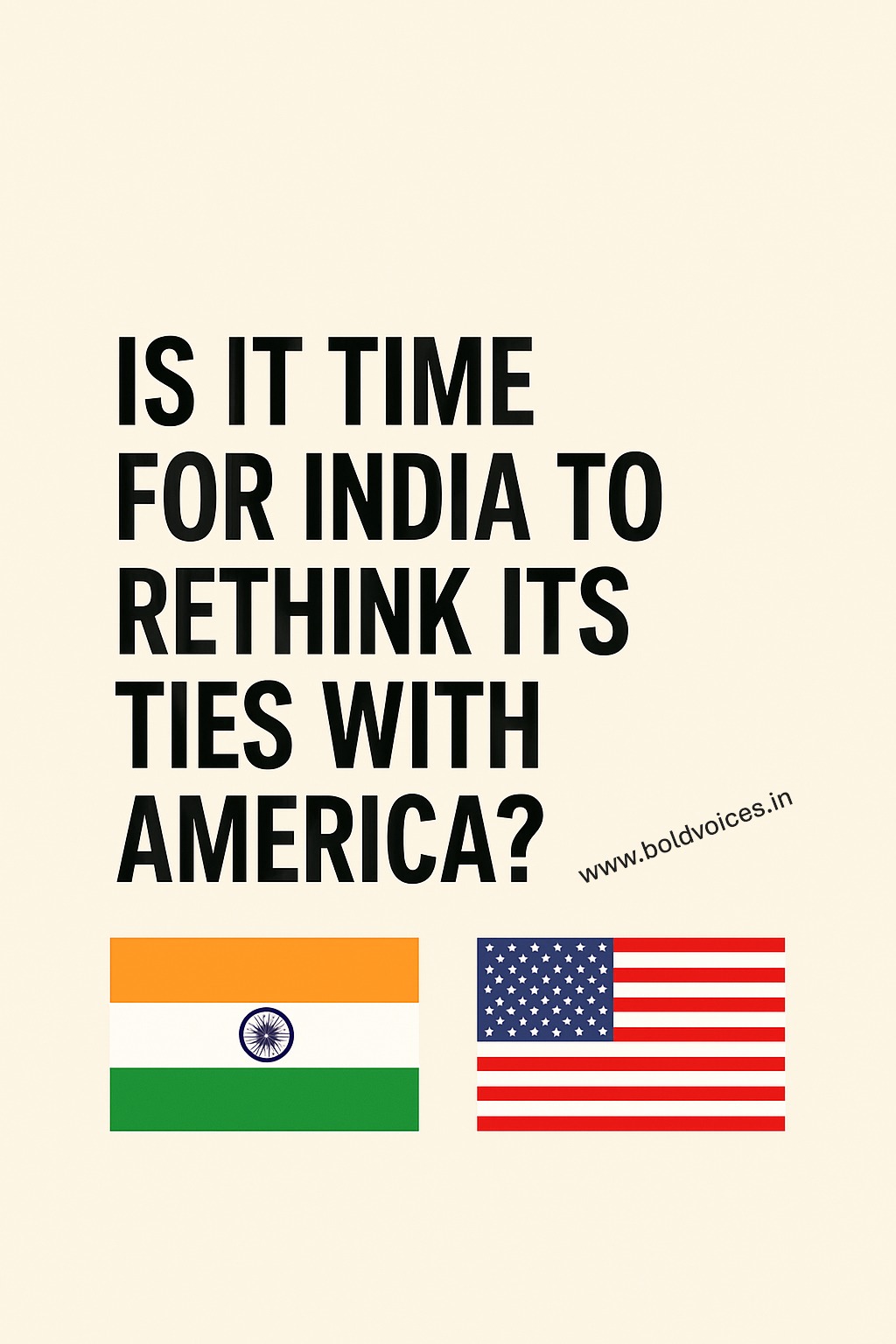
For a stronger Bharat, guided by dharma and diplomacy.
By: Curated by the team of Boldvoices.in Date: 12 June 2025
Introduction
In the arena of global diplomacy, trust is a currency more valuable than gold. Yet in recent times, India finds itself compelled to ask: Can we truly trust America? Despite lofty words of friendship, repeated American actions — especially its continued military and economic support to Pakistan — raise pressing concerns. These decisions not only undermine India’s strategic interests but also embolden forces hostile to peace in South Asia.
As Washington continues to finance Pakistan through global financial institutions like the World Bank and the IMF, and as weapons continue to find their way into Rawalpindi’s military stockpiles, used against both Indian interests and the oppressed people of Balochistan and Afghanistan — the very foundations of Indo-US relations seem to tremble. In this context, should India continue with its traditional non-alignment and strategic autonomy, or is it time to redraw the lines of engagement?
The Troubling Reality of American-Pakistani Relations
America has, time and again, presented itself as a torchbearer of democracy and a warrior against terrorism. Yet its relationship with Pakistan remains an enigma wrapped in contradictions. Despite Pakistan’s long record of sheltering terror networks — from Osama bin Laden to Lashkar-e-Taiba — it continues to receive billions in aid.
In 2025 alone, a fresh loan package was approved by the IMF to prevent Pakistan’s economic collapse, once again with Washington’s backing. While such support is framed as necessary for regional stability, it conveniently overlooks the fact that much of this financial oxygen allows Pakistan to divert resources toward strengthening its military, often with India in its crosshairs.
Weapons supplied to Pakistan, ostensibly for counter-terrorism or border security, frequently end up being used in covert operations and proxy conflicts — from infiltrations in Jammu & Kashmir to crackdowns on Baloch and Pashtun dissenters. For India, this isn’t just a diplomatic concern — it’s a direct national security threat.
A Pattern of Strategic Disregard
America’s duplicity doesn’t end with finances and weapons. In multilateral forums, Washington has often taken positions that are ambivalent at best and biased at worst. Whether it is about ignoring Pakistan’s role in fomenting terror, remaining silent during cross-border ceasefire violations, or offering generous military waivers despite India’s protests — the pattern is too loud to ignore.
For decades, India has kept its doors open to meaningful dialogue, has participated in joint military exercises with the U.S., and has stood by American values in times of global uncertainty. Yet, when it comes to vital Indian concerns, America’s selective vision continues to disappoint.
Should India Stay Neutral?
India’s foreign policy has long embraced the principle of strategic autonomy. From Nehru’s non-alignment movement to today’s multi-aligned diplomacy, India has wisely chosen not to get entangled in rigid blocs. This has allowed it to maintain friendly ties with diverse powers — from Russia to the U.S., from Iran to Israel.
However, neutrality must not become passivity. If a so-called ally repeatedly acts against your interests, does it still deserve the same level of trust and cooperation?
Today’s global order is not what it was in the 20th century. The new Cold War dynamics — whether between the U.S. and China or the emerging trilateral between Russia, Iran, and China — require India to be sharper in its alliances and bolder in its stands.
Time for Recalibration, Not Isolation
India need not sever ties with America — but it must start redefining the relationship based on principled pragmatism. Washington must be made to understand that if it seeks India as a strategic partner in Asia, it must stop aiding those who directly or indirectly threaten Indian sovereignty.
India should:
- Seek greater accountability in global financial aid directed toward Pakistan.
- Insist on technology and defense cooperation that strengthens Indian self-reliance.
- Deepen ties with like-minded partners such as France, Japan, and ASEAN states who have shown consistency in respecting India’s security concerns.
- Strengthen traditional friendships with Russia, Iran, and the Global South — without fear of American displeasure.
- Champion a regional anti-terror axis, including Afghanistan’s legitimate resistance movements and Baloch voices, to expose Pakistan’s internal repression.
Conclusion: The Path Forward
History has shown that India thrives best when it stands rooted in its own strength, not leaning too far in any direction. America may remain a powerful player, but its repeated indulgence of Pakistan has cost it dearly in Indian public opinion.
India must no longer look at diplomacy as a place of hope, but as a chessboard — where every move matters. Friendship must not come at the cost of self-respect. Strategic partnerships must not be blind. And trust, once shaken, must be rebuilt — not begged for.
The time has come not to abandon neutrality, but to evolve it. Neutrality with wisdom. Partnership with conditions. Friendship with clarity.
As Bharat charts its course in the 21st century, one truth stands tall: the world respects those who respect themselves first.
Curated by the team of Boldvoices.in
For a stronger Bharat, guided by dharma and diplomacy.
#StrongerBharat #Dharma #Diplomacy #India #USRelations #Pakistan #StrategicAutonomy #GlobalPolitics #NationalSecurity #AntiTerrorAxis #GlobalSouth #MultilateralDiplomacy #IndianIndependence #ForeignPolicy #TrustInDiplomacy









 BoldVoices.in
Leave a comment