
Sunday, June 1, 2025 Curated by the team of Boldvoices.in
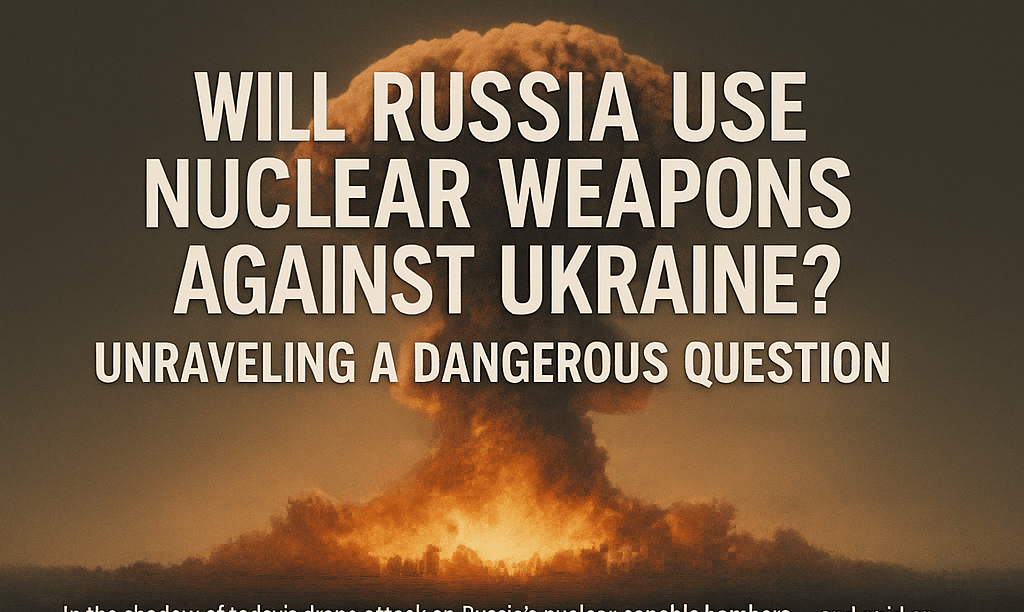
In the shadow of today’s drone attack on Russia’s nuclear-capable bombers — and amid an increasingly volatile battlefield — one question echoes through diplomatic corridors and war rooms alike:
Will Russia resort to nuclear weapons against Ukraine?
This question, once whispered only by fringe analysts, has now become part of mainstream global discourse. As tempers flare and military lines blur, let us unravel the dangers, the doctrines, and the possible roads ahead.
Russia’s Nuclear Doctrine: What the Law Says
Russia’s official military doctrine (updated in 2020) states it may use nuclear weapons only under two conditions:
- If weapons of mass destruction are used against Russia or its allies.
- If the very existence of the Russian state is threatened by conventional means.
Ukraine, so far, has not fulfilled either criterion in legal terms. Kyiv has neither used WMDs nor threatened to invade or dismantle the Russian state. But war doesn’t always follow the letter of law — it follows the pressure of perception.
After the June 1 drone attack that destroyed several strategic bombers, Russian military circles have begun whispering a third, unwritten clause: If strategic humiliation occurs, might that be counted as an existential threat?
Historical Context: From Cold War to Cold Calculations
The fear of nuclear conflict isn’t new. During the Cold War, both Washington and Moscow walked this tightrope for decades — but with red phones, secret backchannels, and clearly drawn lines.
In the Ukraine war, however, those lines are blurrier. The West supplies Kyiv with long-range weapons, intelligence, and satellite data. Moscow increasingly sees NATO as a co-combatant, not a bystander.
But despite fierce rhetoric, Russia has avoided nuclear use even after major setbacks — such as the loss of Kherson in 2022 or the destruction of the Crimean Bridge in 2023. Each time, it turned to missiles, cyberwarfare, and energy blackmail — but stopped short of the nuclear threshold.
Why Using Nukes Is Still Unlikely — But Not Impossible
1. The Global Fallout
Nuclear use would not just be a regional tragedy; it would be a global catastrophe. The radioactive cloud wouldn’t stop at Ukraine’s border. Fallout could spread into NATO territories like Poland, Romania, and beyond — triggering Article 5 and possibly a direct NATO response.
2. China and India’s Red Lines
Russia’s two key global partners — China and India — have repeatedly warned against nuclear escalation. Both have economic interests in global stability and would not support such a move, diplomatically or morally. Beijing, especially, has invested in presenting itself as a peace broker.
3. Russia’s Own Doubts
Even within Moscow’s military elite, opinion is divided. Tactical nuclear strikes are not precision weapons. The environmental, political, and human cost may outweigh the battlefield advantage. Moreover, any first nuclear use would forever isolate Russia, turning it into a pariah among nations.
What Could Change This Equation?
Despite the logic against it, the following situations could increase the risk of Russian nuclear use:
- A complete Ukrainian breakthrough in Crimea, threatening its loss.
- A massive NATO troop presence on Ukrainian soil.
- A deep internal political crisis within Russia, where Putin feels he must act decisively to maintain power.
Most analysts agree: If Putin feels cornered — not militarily, but personally — the risk of drastic decisions increases.
Tactical vs. Strategic Nukes: A Dangerous Distinction
Russia has the world’s largest stockpile of tactical nuclear weapons — smaller warheads designed for battlefield use. These are distinct from strategic nuclear weapons aimed at cities or continents.
A tactical strike could involve a single, low-yield bomb over an unpopulated military area — meant more as a warning than destruction. But even such “limited” use would open a door humanity may never be able to close again.
The West’s Warning: “Consequences Will Be Catastrophic”
U.S. President and NATO leaders have drawn a quiet, firm line: any use of nuclear weapons by Russia would be met with devastating conventional retaliation — targeting Russia’s Black Sea Fleet, air bases, or command centers. Not nuclear in kind, but crippling in impact.
Whether this threat is enough to restrain the Kremlin remains to be seen.
Conclusion: A Cloud That Must Not Rise
As of today, there is no direct evidence that Russia is preparing to launch a nuclear strike. But the silence around Moscow’s intentions — after today’s drone attack — is heavy. And in war, silence is sometimes more dangerous than words.
For now, the nuclear threat remains a specter — haunting the edges of reason, feared more for what it might become than what it is.
But should that line ever be crossed, the war in Ukraine will become something far more terrifying — not just a regional conflict, but a warning to all of humanity.
Let us hope reason, restraint, and history prevail.
Curated by the team of Boldvoices.in









 BoldVoices.in
Leave a comment