
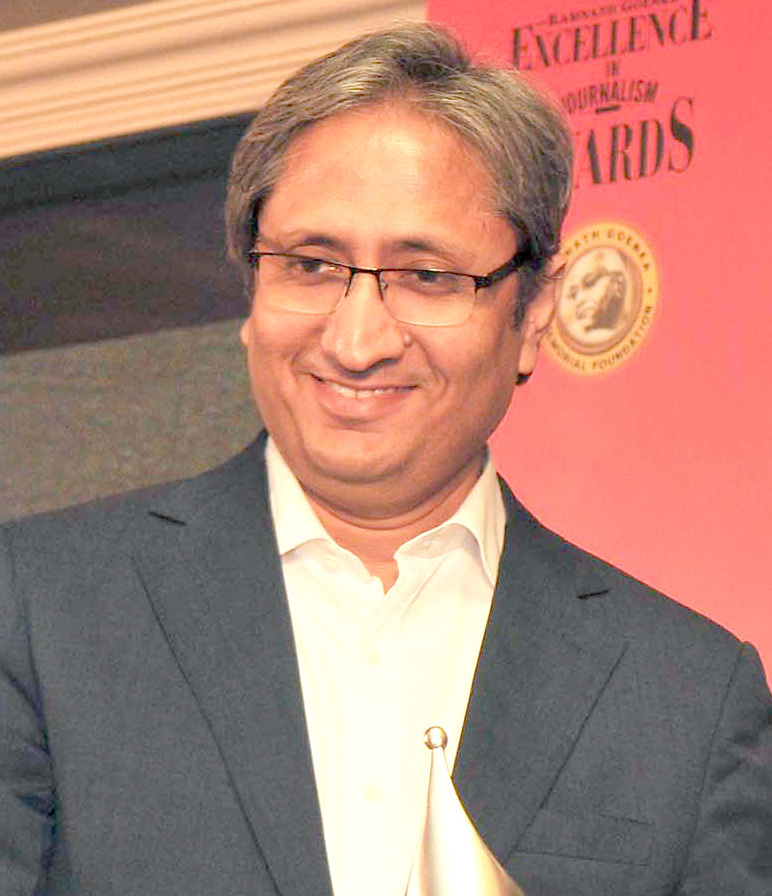
This article presents facts and examples that support the popular criticism that journalist Ravish Kumar is biased against the Bharatiya Janata Party (BJP) and appears sympathetic toward Congress and leftist ideologies.
🟥 1. Consistent Criticism of BJP but Leniency Towards Opposition
Ravish Kumar has been sharply critical of almost every major policy of the Modi-led BJP government, including demonetization, GST, farm laws, handling of the COVID-19 crisis, bulldozer politics, and unemployment.
On his NDTV show “Prime Time”, BJP leaders were either not invited or were made the focal point of harsh criticism, while opposition viewpoints often received more sympathetic treatment.
🟥 2. The Use of the Term “Godi Media” Primarily for BJP-Supporting Channels
Ravish coined and popularized the term “Godi Media” to describe mainstream media channels that he believes are aligned with the BJP.
However, he has rarely if ever used similar terms for media aligned with Congress or Left parties, leading critics to claim selective labeling.
🟥 3. Social Media Behavior: Soft Corner for Congress and Left Voices
An analysis of Ravish Kumar’s past tweets and speeches suggests a frequent targeting of the BJP, while his tone toward leaders like Rahul Gandhi or Left-leaning intellectuals often appears more measured, if not supportive.
During the JNU student protests, Ravish Kumar was clearly supportive of the Left-leaning student unions and critical of the central government’s response.
🟥 4. NDTV’s Editorial Line and Ravish Kumar’s Alignment with It
NDTV, especially during Ravish Kumar’s tenure, was often accused of having a left-leaning editorial stance. Ravish Kumar was one of the most prominent faces of the channel, and his content was frequently seen as aligning with Congress and Left narratives, especially during election seasons.
🟥 5. BJP Leaders Portrayed as Propagandists
On Prime Time, BJP spokespersons were either not invited or given little space to speak.
When they did appear, they were often interrupted or presented in a mocking tone.
In contrast, opposition leaders or panelists supporting them were shown more respect and given more uninterrupted airtime.
🟥 6. Supportive Coverage of Rahul Gandhi’s “Bharat Jodo Yatra”
While many journalists viewed Rahul Gandhi’s Bharat Jodo Yatra as a political campaign, Ravish Kumar presented it in a positive, democratic light, focusing on its social aspects rather than political motives.
This was interpreted by many critics as an attempt to rehabilitate Rahul Gandhi’s public image.
🟥 7. Doubting Media Reports on Murshidabad Violence and Supporting Mamta Banerjee
Ravish Kumar questioned the credibility of media reports about the Murshidabad violence, calling them exaggerated and largely propagated by what he terms “Godi Media.” He advised people to wait before reacting. Instead of criticizing Mamata Banerjee, he once again targeted the media, which critics say reflects his anti-BJP stance and apparent support for Trinamool Congress and the Left.
Conclusion
Based on these observations, it is understandable why Ravish Kumar is frequently labeled as an “anti-BJP” journalist and a supporter of Congress and the Left. His journalism, while critical of the ruling party, appears to some as selectively silent or soft when it comes to the opposition.
April 16, 2025 | New Delhi | Curated By the team at Boldvoices.in





 BoldVoices.in
Leave a comment