
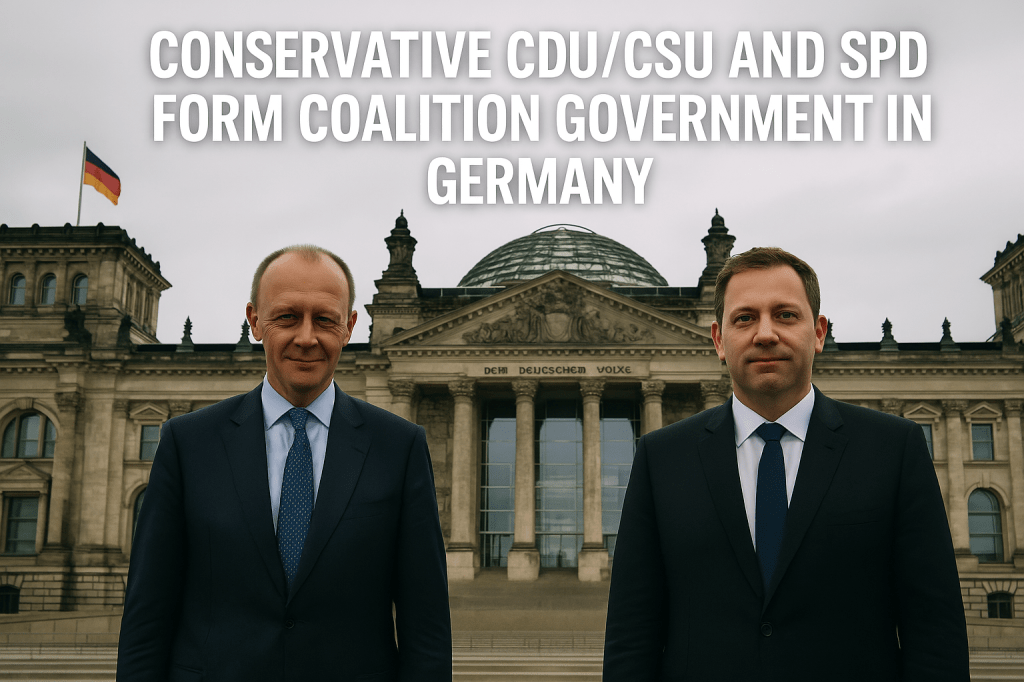
In a significant political development, Germany’s center-right Christian Democratic Union/Christian Social Union (CDU/CSU) and the Social Democratic Party (SPD) have formally agreed to form a grand coalition government. This alliance comes amidst a fragmented political landscape, fueled by the rapid rise of the far-right Alternative für Deutschland (AfD), which made significant electoral gains in the 2025 federal elections.
🗳️ Election Results and Political Context
The 2025 German federal elections saw:
- CDU/CSU: 28.5% of the vote, securing 208 seats
- SPD: 16.4% of the vote, winning 121 seats
- AfD: 20.8% of the vote, finishing in second place with around 150 seats
With 329 seats combined, the CDU/CSU and SPD now hold a majority in the 630-member Bundestag, allowing them to form a stable government. This decision was catalyzed by the urgent need to prevent the AfD from gaining further legitimacy or influence in government.
🤝 Why This Coalition Was Formed
- To Counter Far-Right Momentum: The rise of AfD, fueled by anti-immigration rhetoric and Eurosceptic views, shocked Germany’s political establishment. The coalition is seen as a “firewall” against extremism.
- Need for Stability: Germany has experienced increasing voter volatility, economic pressures, and geopolitical tensions. A stable centrist coalition was viewed as crucial to avoid prolonged political deadlock.
- Pragmatic Centrism: Though ideological differences exist, both CDU/CSU and SPD agreed on several pressing policy areas, particularly fiscal reforms, digital transformation, and controlled immigration.
📜 Coalition Agreement Highlights: “Responsibility for Germany”
The newly signed 146-page coalition agreement includes ambitious initiatives spanning several domains:
1. Economic & Tax Reforms
- Income tax relief for low and middle-income households.
- Gradual reduction of corporate tax rates to stimulate domestic investment.
- Incentives for green industries and start-ups.
2. Immigration & Border Control
- Stricter asylum policies and border checks.
- Legal pathways to skilled migration will be expanded, while illegal migration will be curbed.
- Coordinated deportation mechanisms in line with EU standards.
3. Digital and Infrastructure Overhaul
- Creation of a Ministry for Digitalization to upgrade government services and rural connectivity.
- Investment in AI, cybersecurity, and broadband infrastructure.
- Reform of data protection laws to strike a balance between innovation and privacy.
4. Labor & Social Welfare
- Enhanced minimum wage adjustments.
- Expansion of vocational training programs for youth and migrants.
- Review of the pension system for long-term sustainability.
👥 Leadership Statements
Friedrich Merz (CDU/CSU Leader, Chancellor-Designate):
“This coalition is a commitment to responsible governance. We will act decisively against extremism and lead Germany toward a stronger, digital, and united future.”
Lars Klingbeil (SPD Leader):
“We enter this partnership not out of convenience, but out of necessity. We bring progressive values to a shared table to rebuild trust and economic resilience.”
⚖️ Challenges Ahead
Despite broad agreement, several hurdles remain:
- The SPD’s left wing is skeptical of aligning with conservatives and may resist austerity-leaning proposals.
- CDU/CSU hardliners are wary of SPD-driven social spending.
- Civil society groups have expressed concern over tougher immigration policies.
- AfD remains popular in Eastern Germany, and their base may be emboldened by exclusion from mainstream politics.
🌍 Global and European Implications
- European Union partners have welcomed the coalition as a sign of German stability amid rising right-wing populism across Europe.
- On foreign policy, the coalition emphasizes strong NATO ties, cautious engagement with China, and a firm stance on Russia’s aggression in Ukraine.
- The new government also plans to play a leading role in climate diplomacy ahead of global summits.
🔮 Outlook
This grand coalition is both a strategic shield against polarization and a pragmatic attempt at unity. Whether it can deliver on ambitious reforms while keeping ideological tensions in check will define Germany’s trajectory in the years ahead.
Curated by the team at Bold Voices.







 BoldVoices.in
Leave a comment