
The Relative Strength Index (RSI) is a momentum oscillator that measures the speed and change of price movements. It is primarily used to identify overbought or oversold conditions in a market.
Key Features of RSI
- Formula: The RSI is calculated using the formula:
[
RSI = 100 – \left( \frac{100}{1 + RS} \right)
]where RS (Relative Strength) is the average of “n” days’ up closes divided by the average of “n” days’ down closes.
- Typical Period: The default setting for RSI is a 14-day period, but traders can adjust the period depending on their strategies.
- Value Range: The RSI values range from 0 to 100.
Interpretation of RSI Values
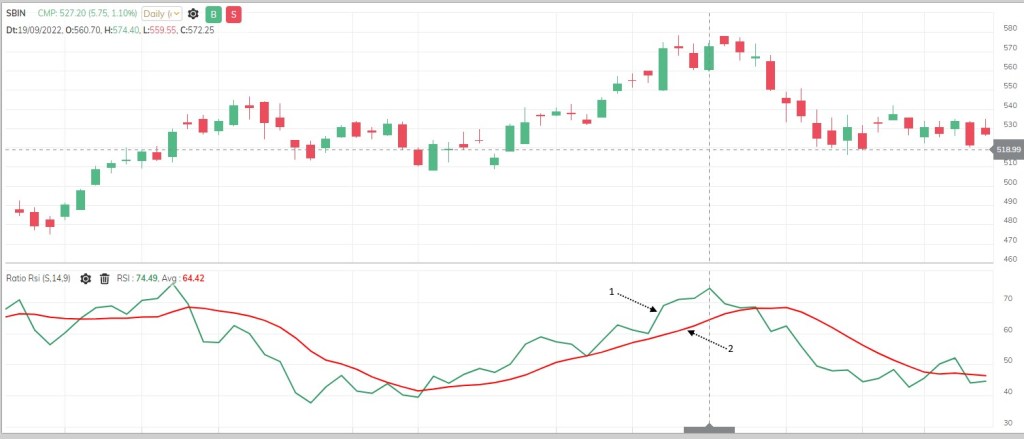
- Overbought Condition: An RSI above 70 typically indicates that an asset is overbought, suggesting it may be due for a price correction or downside.
- Oversold Condition: An RSI below 30 indicates that an asset is oversold, meaning it might experience a price increase or upward correction.
- Bullish Divergence: Occurs when the price makes a new low while the RSI makes a higher low, signaling potential upward reversal.
- Bearish Divergence: Occurs when the price makes a new high while the RSI makes a lower high, signaling potential downward reversal.
How to Use RSI in Trading
- Confirming Trends: Traders can use the RSI to confirm ongoing trends. During an uptrend, the RSI typically stays above 50, while in a downtrend, it remains below 50.
- Entry and Exit Points: RSI can help traders identify optimal entry and exit points by combining it with price action analysis.
- Setting Alerts: Traders often set alerts for when the RSI crosses above or below the overbought (70) and oversold (30) levels.
- Combining with Other Indicators: The RSI is often used in conjunction with other indicators like moving averages or candlestick patterns to enhance trading accuracy.
Advantages of Using RSI
- Simplicity: RSI is easy to calculate and interpret.
- Widely Used: It is a popular tool among traders, adding validity to its signals due to market psychology.
- Adaptability: The RSI can be utilized on various time frames, from minutes to weeks.
Limitations of RSI
- False Signals: The RSI can produce false signals, especially in strong trending markets.
- Lagging Indicator: As a momentum oscillator, it reacts to price movements and may lag behind real-time price changes.
- Not Standalone: RSI should not be used in isolation; it is most effective when combined with other analysis techniques.
Conclusion
The Relative Strength Index (RSI) is a valuable tool for traders looking to identify potential market reversals and confirm trends. Understanding how to read and interpret RSI can aid in making informed trading decisions, but it is essential to use it alongside other indicators and analyses for the best results.










 BoldVoices.in
Leave a comment